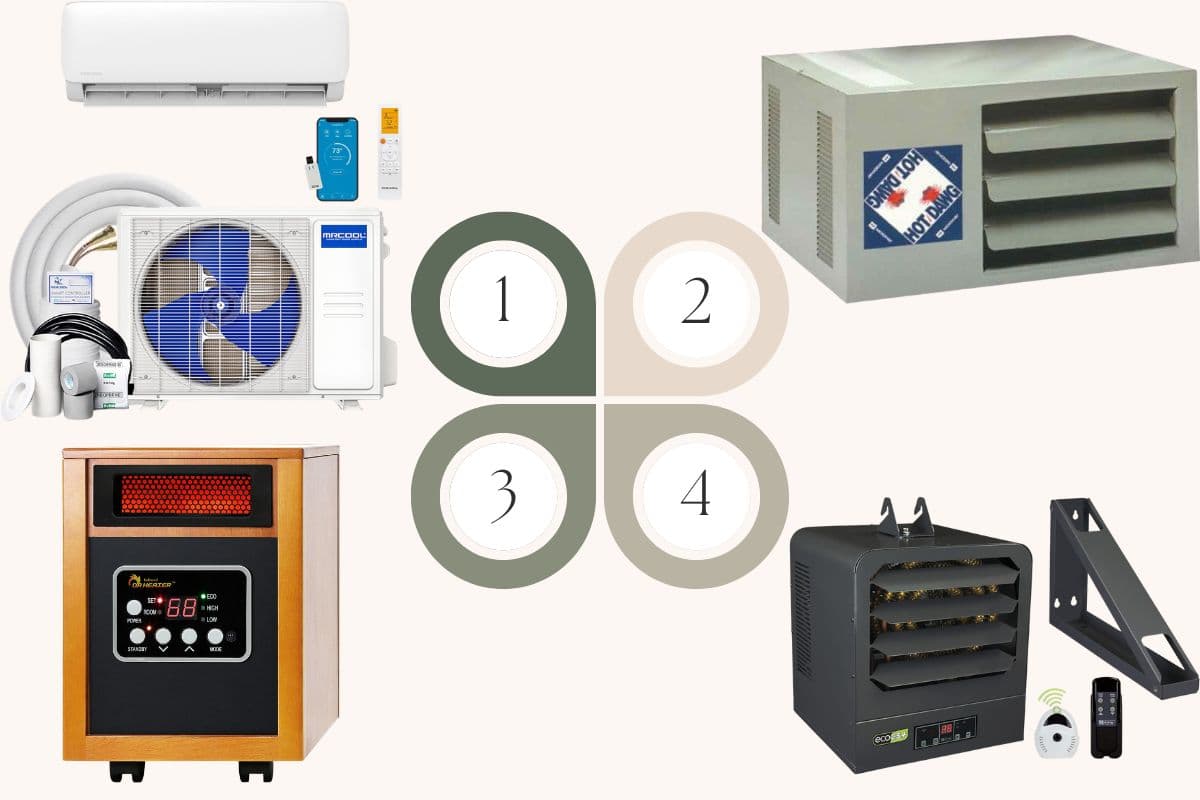
TL;DR
The best garage heater for most homeowners is a 240V electric forced-air unit in the $200 to $500 range. It provides enough heat for a well-insulated two-car garage, requires no gas line or venting, and can be installed in an afternoon with a dedicated circuit.
For larger garages or colder climates where electric cannot keep up, a ceiling-mounted natural gas heater like the Modine Hot Dawg ($400 to $700) is the long-term winner on operating costs. And for homeowners who want both heating and cooling year-round, a ductless mini-split heat pump is the premium play.
We evaluated garage heaters across five categories: electric forced-air, electric infrared, propane portable, natural gas permanent, and mini-split heat pump. Below are our top picks for each use case, with honest notes on what each model does well, where it falls short, and who should buy it.
Quick Comparison Table
| Pick | Model | Type | BTU / Watts | Best For | Price |
|---|---|---|---|---|---|
| Best Overall | Fahrenheat FUH54 | Electric 240V forced-air | 17,065 BTU / 5,000W | Most two-car garages | $180 - $250 |
| Best Heavy Duty | King KB2410-1-B2-ECO | Electric 240V forced-air | 34,130 BTU / 10,000W | Large or poorly insulated garages | $350 - $500 |
| Best Infrared | Dr. Infrared DR-988 | Electric 240V infrared+fan | 19,110 BTU / 5,600W | Woodworking shops, spot heating | $130 - $180 |
| Best Portable Propane | Mr. Heater Big Buddy MH18B | Propane portable | 4,000 - 18,000 BTU | No electrical work, power outages | $150 - $200 |
| Best Natural Gas | Modine Hot Dawg HD45AS0111 | Natural gas ceiling-mount | 45,000 BTU | Regular use, lowest operating cost | $500 - $700 |
| Best 120V Budget | Dr. Infrared DR-968 | Electric 120V infrared | 5,100 BTU / 1,500W | Workbench warmth, small garages | $90 - $130 |
| Best Mini-Split | MrCool DIY 18K 3rd Gen | Ductless heat pump | 18,000 BTU | Year-round heating and cooling | $1,400 - $1,800 |
Fahrenheat FUH54
Price:
$180 - $250
Type:
Electric 240V ceiling-mount forced-air
Heat output:
2,500W / 5,000W (up to 17,065 BTU)
Coverage:
Up to 500 sq ft insulated
Voltage:
208V / 240V hardwired
Thermostat:
Built-in adjustable (45-135 F)
Why it wins: The Fahrenheat FUH54 is the most recommended electric garage heater across professional review sites. It mounts to the ceiling keeping floor space clear, delivers 5,000 watts on the high setting, includes adjustable louvers to direct airflow, and has a built-in thermostat that maintains your target temperature automatically.
What to know: This unit must be hardwired into a 240V circuit. It does not come with a plug or power cord. If you do not already have a 240V outlet in your garage, budget $200 to $500 for an electrician to run a dedicated circuit. The 5,000W output handles a well-insulated two-car garage but may struggle in an uninsulated space or during extreme cold.
Best for: Homeowners who want a permanent, set-and-forget heating solution for a standard two-car garage.
Check Price on AmazonKing KB2410-1-B2-ECO
Price:
$350 - $500
Type:
Electric 240V wall/ceiling-mount forced-air
Heat output:
5,000W / 10,000W two-stage (up to 34,130 BTU)
Coverage:
Up to 1,000 sq ft insulated
Voltage:
240V hardwired
Thermostat:
Built-in digital with ECO2S mode + remote
Why it wins: The King ECO2S is the most powerful residential electric garage heater available. Its two-stage heating (5,000W and 10,000W) lets you run efficiently on the low setting during mild weather and blast the full 10,000W when temperatures drop. The ECO2S smart heating mode automatically adjusts output to maintain temperature with minimal energy waste.
What to know: At 10,000W on the high setting, this heater draws 41.7 amps at 240V. It requires a dedicated 50-amp circuit. Verify your electrical panel has capacity before purchasing. Installation should be done by a licensed electrician.
Best for: Three-car garages, poorly insulated spaces, and homeowners in cold climates who need serious electric heating power without running a gas line.
Check Price on AmazonDr. Infrared Heater DR-988
Price:
$130 - $180
Type:
Electric 240V portable infrared+fan hybrid
Heat output:
5,600W / 19,110 BTU
Coverage:
Up to 600 sq ft (direct radiant)
Voltage:
240V with NEMA 6-30P plug + 6ft cord
Thermostat:
Adjustable 45-95 F
Why it wins: The DR-988 combines infrared radiant heating with a fan-forced air system in one portable unit. The infrared element heats objects and people directly while the fan distributes heat more broadly. It is one of the few 240V garage heaters that comes with a power cord and plug (NEMA 6-30P), meaning no hardwiring is required.
What to know: The NEMA 6-30P plug requires a matching 240V outlet. If your garage does not have one, you will need an electrician to install a 30-amp 240V outlet ($150 to $300).
Best for: Woodworking shops and garages where air quality matters. The infrared component provides immediate warmth without blowing sawdust and debris around.
Check Price on AmazonMr. Heater Big Buddy MH18B
Price:
$150 - $200
Type:
Propane radiant portable
Heat output:
4,000 / 9,000 / 18,000 BTU (3 settings)
Coverage:
Up to 450 sq ft
Fuel:
1-lb propane cylinders or 20-lb tanks
Safety:
ODS, tip-over shutoff, wire guard
Why it wins: The Big Buddy is the most popular portable garage heater in America. It delivers up to 18,000 BTU with zero electrical requirements. Runs on cheap, widely available propane. The oxygen depletion sensor (ODS) automatically shuts the unit off if oxygen levels drop.
What to know: This is a combustion heater. It produces carbon monoxide and moisture as byproducts. You must maintain ventilation and install a battery-operated carbon monoxide detector. Propane costs approximately $0.69 per hour at 18,000 BTU.
Best for: Homeowners who want heat immediately with no installation, no electrician, and no gas line work. Also the only viable option during power outages.
Check Price on AmazonModine HD45AS0111 Hot Dawg
Price:
$500 - $700 (unit only)
Type:
Natural gas ceiling-mount forced-air
Heat output:
45,000 BTU
Coverage:
Up to 1,125 sq ft insulated
Fuel:
Natural gas (LP conversion available)
Venting:
Through-wall or roof (kit sold separately)
Why it wins: The Hot Dawg is the industry standard for permanent garage heating. At 45,000 BTU, it heats even large, moderately insulated three-car garages. Operating cost is the lowest of any heater type at approximately $0.49 per hour on natural gas. Build quality is commercial-grade with an expected lifespan of 15 to 25 years.
What to know: This is not a DIY installation. You need a licensed HVAC technician or plumber. Total installation cost runs $500 to $1,500 if your garage already has a gas line, or $1,500 to $4,000 if a new gas line needs to be run.
Best for: Homeowners who use their garage regularly and have natural gas available. This is the buy-it-once heater that runs for decades at the lowest per-hour cost.
Check Price on AmazonDr. Infrared DR-968
Price:
$90 - $130
Type:
Electric 120V portable infrared
Heat output:
1,500W / 5,100 BTU
Coverage:
Personal/spot heating (up to 150 sq ft)
Voltage:
Standard 120V plug
Thermostat:
Digital with remote (50-86 F)
Why it wins: The DR-968 is the best option for homeowners who want immediate warmth at a workbench without any installation work. Plug it into any standard outlet and it runs instantly. The digital thermostat and included remote control are unusual at this price point.
What to know: At 1,500W, this heater maxes out the capacity of a standard 120V outlet. It will provide personal warmth within a 5 to 8 foot radius but will not heat a full two-car garage.
Best for: Budget-conscious homeowners, renters, and anyone who just wants warmth at the workbench for weekend projects.
Check Price on AmazonMrCool DIY 18K 3rd Gen
Price:
$1,400 - $1,800 (unit only)
Type:
Ductless mini-split heat pump
Heat output:
18,000 BTU heating / 18,000 BTU cooling
Coverage:
Up to 750 sq ft
Voltage:
240V dedicated 20-amp circuit
Efficiency:
SEER 22 / HSPF 10
Why it wins: The MrCool DIY line is the only mini-split system designed for homeowner installation without an HVAC license. The pre-charged line set connects with quick-connect fittings. At 18,000 BTU, it provides serious heating while also delivering air conditioning in summer. The heat pump design produces roughly 3 BTUs of heat for every 1 BTU of electricity consumed.
What to know: You still need to mount the indoor and outdoor units, drill a 3-inch hole through the exterior wall, run the line set and wiring, and connect a 240V circuit. Heating capacity drops in extreme cold (below approximately 0 F).
Best for: Homeowners who use the garage year-round and want both heating and cooling from a single system.
Check Price on AmazonHow to Size a Garage Heater
Choosing the right size heater depends on your garage dimensions, insulation level, climate zone, and target temperature. An undersized heater will run constantly without reaching your desired temperature. An oversized heater cycles on and off too frequently, reducing efficiency.
Quick Sizing Formula
Calculate the cubic footage of your garage (length x width x height). Multiply by the desired temperature rise in degrees Fahrenheit. Divide by a factor based on insulation quality:
- Well insulated (R-13+ walls, R-30+ ceiling): Divide by 4.0
- Moderately insulated (R-8 walls, R-19 ceiling): Divide by 3.0
- Poorly insulated or uninsulated: Divide by 2.0
Sizing by Garage Type
| Garage Size | Sq Ft | Insulated BTU Need | Uninsulated BTU Need | Recommended Heater |
|---|---|---|---|---|
| 1-car | 200-300 | 10,000-15,000 | 20,000-30,000 | Dr. Infrared DR-988 |
| 2-car | 400-576 | 20,000-35,000 | 40,000-70,000 | King ECO2S or Modine Hot Dawg |
| 3-car | 576-900 | 35,000-55,000 | 70,000-110,000 | Modine Hot Dawg or MrCool DIY |
Garage Heater Safety Essentials
Garage heaters involve high voltages, combustion, or both. Following proper safety practices protects your family and property.
Carbon Monoxide Detection
Any combustion heater (propane, natural gas) produces carbon monoxide. Install a battery-operated CO detector in your garage and test it monthly. Never run a combustion heater in a fully sealed space.
Electrical Safety
240V heaters must be on dedicated circuits with properly rated wire gauge. A 5,000W heater at 240V draws 20.8 amps and needs a 30-amp breaker with 10-gauge wire minimum. Never use extension cords with high-wattage heaters.
Clearance Requirements
Maintain minimum clearances from combustible materials as specified by the manufacturer (typically 18 to 36 inches for gas units, 12 to 24 inches for electric). Never store gasoline, paint, or solvents near any heater.
Ventilation
Vented gas heaters exhaust combustion gases through a vent pipe and are safe in sealed garages. Unvented propane heaters require fresh air intake. Crack the garage door 2 to 4 inches when using portable propane units.
Garage Insulation Tips for Better Heating
The single most impactful thing you can do to improve garage heating is to insulate. A well-insulated garage can maintain temperature with half the BTU output of an uninsulated one.
Insulate the Garage Door
The garage door is the largest uninsulated surface. Foam board insulation kits ($50 to $100) can add R-8 to your existing door. For serious heating, consider replacing with an insulated door (R-12 to R-18) for $800 to $2,000 installed.
Seal Air Gaps
Replace worn garage door weatherstripping along the bottom and sides. Caulk gaps around windows, electrical outlets, and where the wall meets the foundation.
Walls and Ceiling
If your garage walls are unfinished (exposed studs), adding R-13 fiberglass batts is an easy DIY project. For the ceiling, R-30 or higher is recommended. Insulating the ceiling alone can reduce heat loss by 25 percent or more.
Frequently Asked Questions
What is the best electric garage heater for a two-car garage?
The Fahrenheat FUH54 (5,000W, 240V) is the best option for a well-insulated two-car garage up to 500 sq ft. For poorly insulated or larger two-car garages, step up to the King KB2410-1-B2-ECO (10,000W, 240V).
Is propane or electric cheaper for garage heating?
Electric is cheaper per hour at lower BTU outputs (under 20,000 BTU). Propane becomes more cost-effective at higher BTU outputs in very cold conditions. Natural gas is the cheapest fuel source overall. Mini-split heat pumps are the cheapest electric option.
Can I install a garage heater myself?
120V plug-in heaters require no installation. 240V hardwired heaters require a dedicated electrical circuit - hire an electrician unless you are licensed. Natural gas heaters require professional installation. MrCool DIY mini-splits are designed for homeowner installation but still require 240V electrical work.
Are garage heaters safe to leave on overnight?
Permanently installed, thermostat-controlled heaters (natural gas, hardwired electric, mini-split) are designed for continuous operation and can safely run overnight. Portable heaters (propane, 120V plug-in) should never be left running unattended or overnight.
How much does it cost to run a garage heater all winter?
A 5,000W electric heater used 4 hours/day, 5 days/week, for 20 weeks costs approximately $300 to $450 per winter at $0.15/kWh. A natural gas heater on the same schedule costs approximately $100 to $200. A mini-split costs approximately $75 to $150.
Do I need to vent my garage heater?
Electric heaters and mini-splits do not require venting. Natural gas heaters must be vented to the outside. Portable propane heaters require ventilation (an open window or cracked garage door) and a carbon monoxide detector.
Related Guides
Garage Ventilation Guide
CFM requirements, depressurization risks, and ventilation solutions
GuideHow to Insulate a Garage
Wall, ceiling, and door insulation to cut heating costs
GuideGarage Too Hot in Summer
The cooling side of the equation
GuideComplete Garage Guide
All 9 garage systems explained for homeowners
GuideEV Charger Installation
Electrical upgrades that pair with a 240V heater install
GuideGarage Workshop Setup
Complete planning guide for turning your garage into a working shop
Garage Heater Glossary
BTU (British Thermal Unit)
The standard measurement of heat output. One BTU is the energy needed to raise one pound of water by one degree Fahrenheit. Higher BTU ratings mean more heating power.
Forced-Air Heater
A heater that uses a fan to blow heated air into the room. Heats the entire space but can blow dust and debris.
Infrared / Radiant Heater
Heats objects and people directly through infrared radiation rather than heating the air. Provides immediate warmth in the line of sight.
Heat Pump / Mini-Split
A system that moves heat from outside air into the garage. Produces roughly 3 BTUs of heat per 1 BTU of electricity, making it the most efficient electric heating option.
ODS (Oxygen Depletion Sensor)
A safety device on propane heaters that automatically shuts off the unit if oxygen levels drop below a safe threshold.
NEMA Plug Types
Standardized electrical plug configurations. NEMA 6-30P is a common 240V 30-amp plug. Standard household outlets are NEMA 5-15 (120V, 15-amp).