GG
The Garage Guide
Updated Mar 2026 · 16 min read
How to Set Up a Garage Workshop: The Complete Planning Guide
How to set up a garage workshop from scratch. Zone planning, electrical circuits, lighting, workbench placement, flooring, ventilation, and tool storage.
TL;DR
A functional garage workshop starts with four things in the right order: plan your zones before buying anything, get your electrical sorted before installing anything permanent, light the space to 100 lumens per square foot minimum, and put the workbench where the best light is. Everything else (flooring, storage, heating, ventilation) follows from those four decisions. Budget $500 to $2,000 for a solid starter setup. A fully equipped dedicated workshop runs $5,000 to $15,000 over time, built in phases.
There is a moment every garage workshop owner remembers. You are three hours into a project, sawdust in your hair, music playing, and everything you need is exactly where it should be. The drill is on the pegboard. The clamps are on the rack. The work light hits the bench at exactly the right angle. The door to the house is 15 feet away. That moment does not happen by accident. It happens because someone took two hours to plan before buying a single shelf bracket.
The most common garage workshop mistake is starting with tools and storage and working backward to the space. Buy the workbench, then figure out where to put it. Install the pegboard, then realize it is blocking the light switch. Run extension cords because the outlets are in the wrong spots.
This guide does it in the right order: planning first, then electrical, then light, then everything else, so your workshop works the first time you use it.
Step 1: Plan Your Zones Before You Buy Anything
The single most important thing you can do before spending a dollar is map your workshop on paper. A zone-planned workshop feels twice as large as the same space without zones, because you are never fighting your own layout.
The Zone-First Rule
No tool, no storage system, and no permanent fixture goes in until the zones are drawn. This sounds simple. Almost nobody does it. The homeowners who skip this step spend the next three years moving things around. The ones who do it spend two hours with graph paper and never move anything again.
The Four Zones of a Working Shop
The Work Zone — Centered on your workbench. This is where you make things. It needs the best light, the easiest access to hand tools, and at least 3 feet of clear floor space on three sides for material handling. Place this zone near natural light if you have a window, or plan for your best overhead fixture here.
The Tool Zone — Where power tools live. Stationary tools (table saw, miter saw, drill press) need floor space, electrical access, and clearance for material feed. A 10-inch table saw needs about 8 feet of clearance in front and behind for ripping full sheets. A miter saw needs 10 feet of total length for crosscutting long stock. Plan this before you set a single tool down.
The Storage Zone — Walls and overhead space for everything that is not in use. Wall tracks, pegboard, cabinets, and ceiling racks all live here. This zone keeps the floor clear, which is the single biggest difference between a workshop that works and one that does not.
The Materials Zone — Where raw materials live before they become projects. Lumber needs a rack. Sheet goods need vertical storage. Hardware needs bins. Put this zone near the garage door so you can unload materials without carrying them across the shop.
The Work Triangle
Borrow a concept from kitchen design: the work triangle. Your workbench, your primary stationary tool, and your materials storage should form a triangle where no side is more than 6 feet. Every step you take between these three points during a project is wasted time. In practice, this means your miter saw or table saw should be close to your bench, and your lumber rack should be close to both.
Measuring Your Space
Before drawing anything, measure everything:
- Total floor dimensions
- Ceiling height (affects what you can hang and whether a car lift is feasible)
- Door locations and swing clearances
- Window locations and which direction they face (north light is best for color-accurate work)
- Existing outlet locations and breaker panel location
- Any fixed obstructions: columns, water heaters, HVAC equipment
Leave at least 36 inches of walkway clearance around all work areas. The National Fire Protection Association recommends 36-inch minimum clear paths to exits in workshop spaces, both for safety and for sanity when you are moving long stock.
Step 2: Get the Electrical Right
This is the step most homeowners skip until they are frustrated with tripping breakers and running extension cords. Do not skip it. Getting the electrical right before you install permanent storage and equipment saves you from tearing out shelving to run conduit later.
What a Garage Workshop Actually Needs
A basic garage typically comes with one 20-amp circuit for general outlets and a separate circuit for lighting. This is not enough for a working shop. Here is what you actually need:
| Circuit | Amperage | What It Powers |
|---|---|---|
| General outlets (x2) | 20A each at 120V | Cordless tool chargers, shop vac, small tools |
| Lighting | 20A at 120V | Keep this separate. You want lights on when a tool trips a breaker |
| Table saw or primary stationary tool | 20A at 240V | Table saw, jointer, planer |
| Dust collector | 20A at 240V | Dedicated so it runs simultaneously with a saw |
| Air compressor | 20A at 120V or 240V | Check your compressor nameplate |
| Workbench outlet strip | 20A at 120V | Hand tools, chargers, task lights |
The 240V advantage: Running a tool at 240V instead of 120V cuts the amperage draw in half. A 14-amp table saw at 120V becomes a 7-amp load at 240V. This means you can often run the table saw and dust collector simultaneously on a single 20-amp 240V circuit. Most stationary tools that are rated for both voltages will run significantly cooler and more reliably at 240V.
The 80% rule: Electrical code requires that continuous loads on a circuit stay at or below 80% of the circuit's capacity. On a 20-amp circuit, that means 16 amps of actual load. Do not run a 16-amp table saw and a 12-amp dust collector on the same 20-amp circuit. They exceed 80% of capacity together.
Subpanel for serious setups: If you plan on multiple 240V circuits, an air compressor, a heater, and an EV charger, run a subpanel. A 60-amp subpanel installed by an electrician costs $500 to $1,200 and gives you a clean, expandable electrical backbone for the entire shop. A 100-amp subpanel costs only slightly more and gives you room to grow. See our EV charger installation guide if you want to include Level 2 charging in the plan.
For a complete guide to running power from your main panel to a detached garage including load calculations, wire gauge, and permit requirements, see our detached garage electrical guide.
Outlet placement: Put outlets at 48 inches height on walls, not at floor level. You want them at countertop height on the workbench wall, and at chest height on the tool wall so cords do not drag across the floor. Install a minimum of one outlet every 6 feet around the perimeter. This eliminates extension cords entirely in most shops.
Step 3: Light It Properly
Most garage workshops are criminally underlit. A single overhead fixture or two old fluorescents is enough to find your keys, not enough to work safely with sharp tools. The difference between adequate lighting and proper workshop lighting is the difference between straining your eyes and seeing the pencil line clearly on the first try.
The Lighting Formula
Calculate your total lumen requirement before buying a single fixture:
- General use shop (parking, occasional projects): 50 lumens per square foot
- Active workshop (regular projects, hobby work): 75 lumens per square foot
- Precision work (woodworking, electronics, detail finishing): 100 lumens per square foot
A 400 square foot two-car garage workshop needs 30,000 to 40,000 lumens for serious work. Four Hykolity 4-foot LED shop lights at 4,400 lumens each gives you 17,600 lumens for $55 to $75. Add two more packs and you are at 35,000 lumens for under $150. See our best garage lighting guide for specific fixture picks.
Color Temperature and CRI
Always use 5000K daylight white in a workshop. It closely mimics natural sunlight, makes it easier to see pencil lines on wood, and reduces eye fatigue during long sessions. Never use warm white (2700K to 3000K). It makes the shop feel dim and makes it nearly impossible to distinguish similar paint colors or wood tones. Buy fixtures with a CRI (Color Rendering Index) of 80 or higher. CRI measures how accurately a light renders colors compared to natural sunlight. Below 80, everything looks slightly washed out and you lose the ability to distinguish subtle differences in material color, finish sheen, or stain depth.
Task Lighting at the Bench
Overhead lighting casts shadows on the workbench from your own body. A task light mounted directly above or on the bench itself eliminates this. Under-cabinet LED strips or a dedicated adjustable arm lamp at the bench gives you shadow-free illumination on the work surface. This is not optional for precision work. It is the difference between catching a tear-out before it matters and finding it after you have already sanded.
Step 4: Choose and Position Your Workbench
The workbench is the heart of the workshop. Everything else orbits it. Get its position and height right before anything else is permanent.
The Right Height
Standard workbench height is 34 to 36 inches for standing work. The rule of thumb: stand with your arms relaxed at your sides and make a fist. The top of your fist should be at or slightly above bench height. At this height, you can apply downward pressure on a hand plane, push a chisel, or use a hand saw without hunching or reaching up. For workbench use that involves a lot of clamping and vise work, a slightly lower bench (32 to 34 inches) can be better. For detail work or assembly of small parts, higher (36 to 38 inches) reduces neck strain.
Workbench Positioning
Put the bench under your best light, perpendicular to the primary light source if possible. This creates shadow that helps you see surface texture, joinery gaps, and pencil lines. A bench positioned with light coming directly from above is worse than one with light coming from the side at a slight angle. Leave 3 feet of clear space on the left side for long material support, and 3 feet at the front. The right side can be tighter if that is your wall storage side.
What to Look For in a Bench
For a serious workshop, the minimum specifications are:
- Work surface: 48 x 24 inches minimum (60 x 24 inches is better for most projects)
- Weight capacity: 1,500 lbs minimum
- Surface material: solid rubberwood, hardwood, or MDF with hardwood edging (avoid particle board)
- Vise or vise mounting: at least one front vise for clamping work
- Built-in power: 4 outlets and 2 USB ports saves an extension cord
See our best garage workbenches guide for tested picks at every price point.
Step 5: Floor — Do Not Skip It
You will stand on this floor for hours. A bare concrete floor is cold, hard on joints, dusty, and absorbs oil and stains that attract slipping hazards. A properly finished floor changes the feel of the entire shop.
Epoxy Coating
An epoxy-coated floor is the gold standard for a workshop. It seals the concrete against oil, chemicals, and moisture. Spills wipe up instead of soaking in. Dropped tools slide rather than chip. Anti-slip flakes embedded in the surface add traction. A DIY epoxy kit for a two-car garage costs $200 to $280 for a polycuramine product like Rust-Oleum RockSolid. Professional coating costs $3 to $7 per square foot. Critical rule: remove all oil stains before coating. Oil contamination under epoxy causes the coating to fail within months. See our garage floor oil stains guide for removal methods, and our garage floor epoxy guide for kit comparisons.
Anti-Fatigue Mats
Even with an epoxy floor, standing on concrete for two to four hours causes significant leg and back fatigue. Anti-fatigue mats placed at the workbench and primary stationary tool positions reduce this substantially. 3/4-inch thick foam or rubber mats cost $30 to $80 per station and make a noticeable difference on long project days.
Step 6: Storage — Walls Up, Floor Clear
The guiding principle for workshop storage is simple: everything off the floor except tools in use. A clear floor means you can move freely, change your layout, sweep sawdust, and roll tools where you need them.
Wall Storage Priority
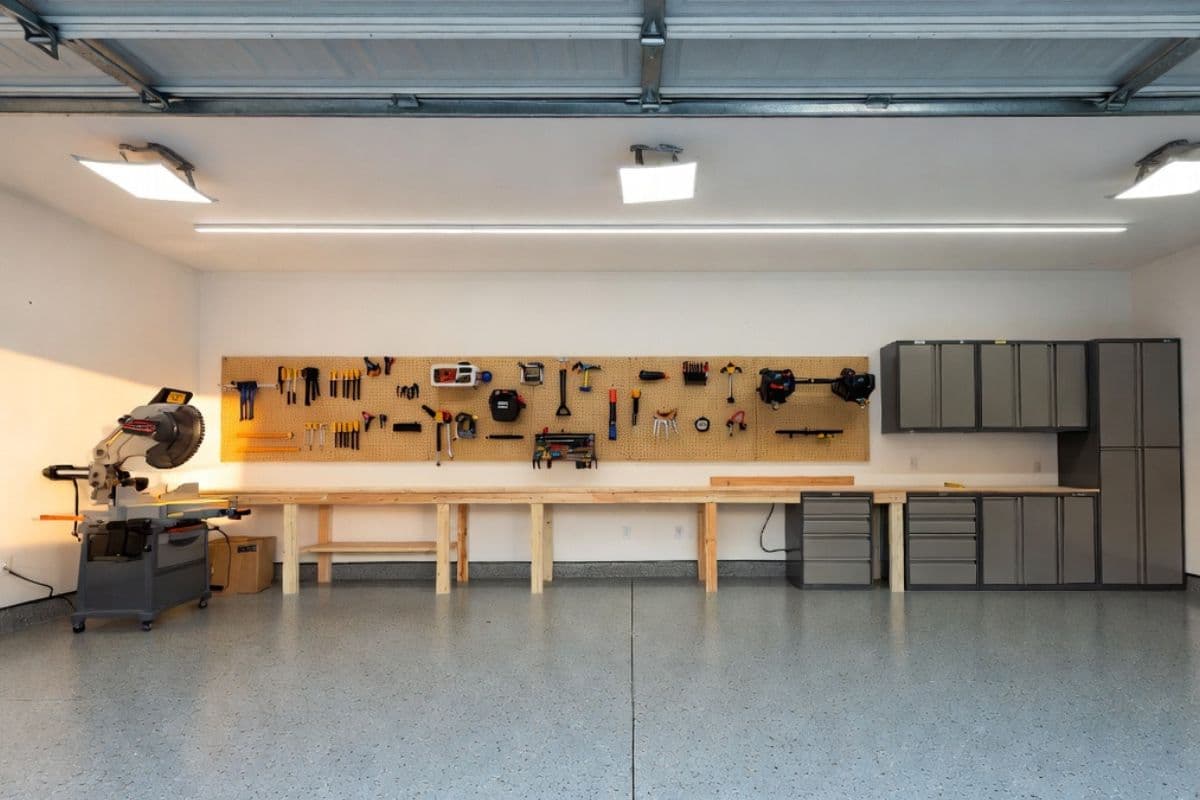
Hand tools: Pegboard or wall track systems put frequently used tools at eye level within arm's reach of the bench. The shadow board method (outlines of each tool drawn on the pegboard) makes it immediately obvious when a tool is missing.
Power tools: A wall track or mounted bracket system for drills, circular saws, and similar tools keeps them charged and accessible. Milwaukee, DeWalt, and Ridgid all make brand-specific wall storage systems that integrate with their tool lines.
Clamps: A dedicated clamp rack on the wall saves an enormous amount of time. Clamps that are stacked on a shelf are clamps you spend three minutes untangling every time you need one.
For full wall storage system recommendations, see our best garage storage systems guide.
Cabinet Storage
Cabinets are the right choice for hardware, finishing supplies, chemicals, and any tools that should be kept dust-free. A steel cabinet with locking doors protects expensive power tools and keeps chemicals safely contained and out of reach of children. See our best garage cabinets guide for system options.
Overhead Storage
Ceiling racks (Fleximounts, SafeRacks) are the right place for sheet goods, long lumber, seasonal materials, and anything you access less than once a week. A 4x8 overhead rack rated for 600 lbs costs $150 to $250 and clears an enormous amount of floor and wall space. Mount only into ceiling joists, not drywall.
Step 7: Ventilation and Dust Control
Two things damage lungs in a workshop: fine dust from sanding and cutting, and fumes from finishing products. Neither is visible in the air at dangerous concentrations. Both require active ventilation.
Dust Collection
For any shop with a table saw, miter saw, or sander, a dust collector is not optional for regular use. Fine wood dust is both a health hazard and a fire risk. OSHA classifies wood dust as a carcinogen at sufficient concentrations, and sawdust accumulation on motors and in corners creates a fire ignition risk. A single-stage 1 HP dust collector ($200 to $350) handles most benchtop and portable tools through flexible hose connections. For a multi-tool shop, a 1.5 to 2 HP unit ($350 to $600) with a dedicated 240V circuit handles continuous operation more effectively.
Minimum setup: A shop vacuum with a fine dust filter at the bench and a 1 HP dust collector at the table saw. This captures the majority of airborne particles from the two highest-volume dust sources.
Air Circulation and Fume Removal
For finishing work (staining, painting, applying polyurethane), you need active air exchange, not just a ceiling fan. Open the garage door and use a box fan to pull air through the space from a clean air intake on the opposite side. For enclosed shops, a wall-mounted exhaust fan rated for the shop's volume provides continuous air exchange. See our garage ventilation guide for CFM calculations and fan recommendations.
Workshop noise is one of the most common sources of neighbor complaints for garage shop owners. Power tools like table saws, miter saws, and router tables regularly exceed 100 decibels at typical operating distance, loud enough to be heard several houses away from an uninsulated garage. If noise is an issue, soundproofing the garage walls and door significantly reduces the sound reaching neighbors. See our garage soundproofing guide for step-by-step DIY approaches and material comparisons.
Step 8: Heating and Cooling
A shop you cannot use in January or August is half a shop. Thermal comfort expands how many months per year your workshop is actually usable, and it protects materials. Wood acclimates to its environment, and extreme temperature swings cause lumber to move.
Winter Heating
For a well-insulated two-car garage shop, a 240V electric forced-air heater (5,000W, $180 to $250) handles heating adequately. For a poorly insulated or larger space, a natural gas ceiling heater like the Modine Hot Dawg (45,000 BTU, $500 to $700) is the long-term cost winner.
Critical for Workshops
Never use an unvented propane or kerosene heater in a workshop with sawdust accumulation. Fine dust in the air combined with an open flame is a genuine fire and explosion hazard. Use only electric or properly vented gas heaters.
See our best garage heaters guide for sizing and product recommendations.
Summer Cooling
A ceiling fan provides comfort on mild days but cannot cool a shop on a 95-degree afternoon. Options in order of cost and effectiveness:
- Box fan in window or garage door: $30 to $50, provides airflow only
- Window AC unit (8,000 to 12,000 BTU): $200 to $400, cools the space but requires a 120V or 240V outlet
- Mini-split heat pump (18,000 BTU): $1,400 to $1,800 installed, provides both heating and cooling year-round from a single system
A mini-split is the long-term answer for a year-round shop. The upfront cost is higher but the operating cost is lower than electric resistance heating, and it eliminates the need for a separate cooling solution.
Step 9: Safety Essentials
A great shop is a safe shop. These are not optional additions. They are non-negotiable before you turn on the first tool.
Fire Extinguisher
Mount a 10-pound ABC-rated fire extinguisher within 30 feet of your work area, at a height between 3.5 and 5 feet off the floor. ABC-rated means it handles wood, electrical, and chemical fires, all three of which are possible in a workshop. The National Fire Protection Association (NFPA) recommends one extinguisher per 3,000 square feet of workshop space, but in a home garage shop, one good extinguisher mounted near the exit is the correct baseline. Check it annually. An extinguisher that has not been inspected in three years may not function when you need it.
Flammables Storage
Finishing products (stains, varnishes, lacquers, paint thinner, acetone) are flammable liquids that should never be stored in a cabinet next to heat sources or in quantities larger than what you need for the current project. A metal flammables cabinet ($80 to $200) is the correct storage solution. Keep the quantity in the shop to the minimum needed for your current project and store the rest elsewhere.
First Aid Kit
A workshop first aid kit needs more than bandages. Stock it with gauze pads for larger cuts, a tourniquet for serious lacerations, eye wash, and burn treatment. Mount it on the wall near the exit, visible and accessible, not tucked in a drawer.
Personal Protection Equipment (PPE)
- Eye protection: Safety glasses for every power tool operation, full face shield for lathe work and grinding
- Hearing protection: 85 decibels is the threshold for hearing damage over extended exposure. A table saw typically runs 90 to 100 dB. Use earplugs or earmuffs rated for the noise level of your tools
- Dust mask: An N95 for general shop work. A P100 respirator for sanding, routing, or finishing work
- Cut-resistant gloves: For material handling, not for power tool operation, where gloves can catch
Budget Breakdown: What a Workshop Actually Costs
There is no single right budget for a workshop. There is a progression. Build in phases.
| Phase | What It Includes | Approximate Cost |
|---|---|---|
| Phase 1: Functional basics | Workbench, basic hand tools, pegboard, shop lighting upgrade, 20A circuit | $500 to $1,200 |
| Phase 2: Core power tools | Table saw or miter saw, drill press, shop vac, dust collector | $1,500 to $3,000 |
| Phase 3: Storage system | Wall track or cabinet system, ceiling rack, clamp rack | $500 to $2,000 |
| Phase 4: Comfort and safety | Floor coating, heating, ventilation, fire extinguisher, PPE | $500 to $2,500 |
| Phase 5: Serious capability | 240V subpanel, additional stationary tools, air compressor | $1,500 to $5,000 |
The right approach: Do Phase 1 completely before starting Phase 2. A well-lit bench with proper hand tools and a clean floor produces better results than an expensive table saw in a dark, disorganized space.
Seasonal Considerations
Spring and Summer
Spring is the best time to do the planning and infrastructure work (floor coating, electrical upgrades, ventilation installation), before the heat of summer makes working in the garage uncomfortable. Epoxy floor coatings require temperatures between 50 and 90 degrees Fahrenheit to cure correctly. Summer heat in an uninsulated garage regularly exceeds 110 degrees in warm climates, making extended work sessions physically demanding and potentially dangerous. A window AC unit ($200 to $400) or a ceiling fan combined with the garage door open makes summer sessions much more manageable and keeps your lumber from moving due to humidity swings.
Fall and Winter
Fall is the time to seal the shop against winter. Check weather seals, add door insulation, and confirm your heating solution is working before the first freeze. Wood movement from temperature and humidity swings is the enemy of precise joinery, and a climate-stable shop produces better work year-round. In winter, never store finishing products where they can freeze. Latex paint, water-based stains, and some finishes are permanently damaged by freezing and must be kept above 40 degrees Fahrenheit.
For the full year-round maintenance schedule covering all nine garage systems, see our complete garage maintenance checklist.
Frequently Asked Questions
How much does it cost to set up a garage workshop?
A functional starter workshop costs $500 to $1,200 for a workbench, basic lighting upgrade, pegboard wall storage, and a hand tool set. Adding core power tools (table saw, miter saw, drill press) runs $1,500 to $3,000. A complete setup with floor coating, proper ventilation, cabinet storage, and a 240V subpanel runs $5,000 to $15,000 built over time in phases. The key is starting with the infrastructure (electrical and lighting) before filling the space with tools and storage.
What electrical circuits does a garage workshop need?
At minimum: two dedicated 20-amp 120V circuits for general outlets, one separate 20-amp circuit for lighting, and one 20-amp 240V circuit for your primary stationary tool. A fully equipped shop also needs a dedicated 240V circuit for the dust collector, a circuit for the air compressor, and a workbench outlet strip on its own circuit. If you plan on multiple 240V tools, a 60 to 100-amp subpanel gives you a clean, expandable electrical backbone and costs $500 to $1,200 installed.
What is the best flooring for a garage workshop?
An epoxy or polycuramine coating is the best choice. It seals the concrete against oil and chemicals, makes spills easy to clean up, reduces dust, and provides a comfortable surface. A DIY polycuramine kit like Rust-Oleum RockSolid costs $200 to $280 for a two-car garage. Remove all oil stains before coating. Oil contamination causes the coating to fail. Add anti-fatigue mats at the workbench and primary tool positions to reduce leg fatigue on long project days.
What is the first thing to do when setting up a garage workshop?
Plan your zones on paper before buying anything. Measure the space, map the four zones (work, tool, storage, materials), identify where your electrical panel is and what circuits you have, and decide where the workbench goes. Two hours of planning prevents months of frustration. The most common mistake is starting with tools and storage and working backward. You end up with outlets in the wrong places, shelving blocking the light switch, and a layout that fights your workflow instead of supporting it.
Can I use a propane heater in my garage workshop?
Not safely if you have sawdust accumulation. Fine wood dust suspended in air combined with an open flame is a genuine fire and explosion hazard. Use only electric forced-air heaters or properly vented gas heaters like the Modine Hot Dawg with through-wall or roof venting. If you have no electrical heating option and must use propane, run the dust collector for 5 minutes before turning on the heater to clear airborne particles, ensure active ventilation, and install a battery-operated carbon monoxide detector.
How do I keep my workshop organized long-term?
The single most effective habit is the one-in-one-out rule for tools: every new tool gets a designated spot before it comes into the shop. If there is no spot, something has to move or leave before the new tool arrives. Shadow boards on the pegboard make it immediately obvious when a tool has not been returned. A weekly 15-minute sweep (tools back to their spots, scraps in the bin, floor cleared) keeps entropy from accumulating. The shops that stay organized are the ones where everything has a home, not the ones with the most expensive storage systems.
How much lighting does a garage workshop need?
Target 75 to 100 lumens per square foot for active workshop use. A 400 square foot two-car garage needs 30,000 to 40,000 lumens. Four Hykolity 4-foot LED shop lights at 4,400 lumens each provides 17,600 lumens for $55 to $75. You will likely want two packs for a full two-car garage. Use 5000K daylight white color temperature and fixtures with a CRI of 80 or higher. Add a dedicated task light at the workbench to eliminate shadows from overhead fixtures.
Do I need a dust collector for a garage workshop?
For any regular use of a table saw, miter saw, or random orbit sander, yes. Fine wood dust is classified as a carcinogen at sufficient concentrations, and sawdust accumulation on motors and in corners creates a fire ignition risk. A 1 HP single-stage dust collector costs $200 to $350 and handles most benchtop and portable tools through flexible hose connections. Pair it with a shop vacuum at the workbench for hand tool and detail work. This combination captures the majority of airborne particles from the two highest-volume dust sources.
Related Guides
Best Garage Lighting
LED shop lights, high bays, and wraparounds for every workshop size.
ReviewBest Garage Workbenches
Tested picks from $180 to $550.
ReviewBest Garage Cabinets
Steel storage systems for tools and hardware.
ReviewBest Garage Storage Systems
Wall tracks, ceiling racks, and pegboard compared.
GuideGarage Ventilation Guide
CFM requirements and fan selection for dust and fume control.
ReviewBest Garage Heaters
Electric, gas, and infrared options for year-round comfort.
GuideEV Charger Installation
Add Level 2 charging to your workshop electrical plan.
ReviewBest Garage Floor Epoxy
DIY coating kits that actually last.
Glossary
Zone planning
The process of dividing a workshop into dedicated functional areas (work, tool, storage, materials) before installing any equipment or storage. Zone planning ensures the layout supports workflow rather than fighting it, and prevents the most common workshop mistakes: outlets in the wrong spots, storage blocking light, and tools positioned for conflict rather than flow.
Subpanel
A secondary electrical panel installed in or near the garage, fed from the main house panel, that provides dedicated circuits for the workshop. A 60 to 100-amp subpanel allows multiple 240V circuits, plenty of 120V general circuits, and room for future expansion including EV charging. Required for any serious multi-tool shop setup. Installation costs $500 to $1,200 with an electrician.
240V circuit
An electrical circuit operating at 240 volts, used for high-power tools including table saws, jointers, planers, air compressors, and dust collectors. Running a tool at 240V cuts amperage draw in half compared to 120V, allowing more tools to share circuits and reducing motor heat. Most stationary woodworking tools perform better on 240V and should be wired for it if the option exists.
Lumens per square foot (foot-candles)
A measure of light intensity at the work surface. Workshop best practice is 75 to 100 lumens per square foot for active use. Inadequate lighting is the most commonly overlooked workshop safety hazard. Poor visibility while operating sharp tools directly increases the risk of injury.
Dust collector
A dedicated filtration and collection system that captures wood dust at the source (the tool) rather than allowing it to become airborne. Distinct from a shop vacuum in that it is designed for continuous high-volume operation and captures fine particles that pass through standard shop vac filters. Required for regular table saw and miter saw use in any enclosed shop.
Anti-fatigue mat
A thick foam or rubber mat placed on hard flooring at standing work stations. Reduces leg and back fatigue during extended standing, which is directly linked to lower back pain in workshop users. The 3/4-inch thickness provides the correct balance of cushioning and stability for tool operation.
CRI (Color Rendering Index)
A measure of how accurately a light source renders colors compared to natural sunlight (CRI 100). Fixtures below CRI 80 make it difficult to distinguish similar wood tones, finish sheen levels, or paint colors. For a workshop, CRI 80 is the minimum acceptable value; CRI 90 or above is preferable for finishing work.
Shadow board
A storage system where the outline of each tool is drawn or cut into the pegboard or wall panel behind its hanging position. Makes it immediately obvious when a tool has been removed and not returned. Highly effective for maintaining organization in a shared shop or when working on complex projects with many tools in simultaneous use.
Get Homeowner Tips in Your Inbox
Seasonal maintenance reminders, repair guides, and money-saving tips from The Garage Guide — delivered free to your inbox.
By subscribing you agree to receive emails from The Home Guide Network. We respect your privacy. Unsubscribe anytime. Privacy Policy
Get Expert Garage Help
Connect with qualified garage professionals in your area. Free quotes, no obligation.