The Garage Guide
Updated Apr 2026 · 12 min read
Garage Door Off Track: Causes, How to Fix It, and When to Call a Pro
Diagnose the cause, fix minor derailments safely, and know exactly when to stop and call a professional.
TL;DR
Stop operating the door immediately. Do not force it. Pull the red emergency release cord to disconnect the opener and secure the door with locking pliers so it cannot move while you diagnose the problem. If the door is slightly off track with no broken cables, bent tracks, or spring damage, a careful homeowner can guide the rollers back in. If the door is crooked, a cable is broken, a spring is damaged, or the track is bent, stop and call a pro. A garage door weighs 130 to 350 pounds and operates under extreme spring tension. The wrong move causes serious injury.
The door started grinding on the way down. Or it stopped halfway and sits at a crooked angle. Or it opened fine this morning and now the opener strains against it and nothing moves. Any of these mean the same thing: one or more rollers have left the track, and the door is no longer guided by the system it depends on to move safely.
A garage door off track is one of the most common calls a garage door technician receives. It is also one of the most dangerous problems a homeowner can attempt to fix incorrectly. The door is heavy. The springs are under enormous tension. And a door that drops unexpectedly in an attempt to muscle it back into alignment can crush a hand, crack a foot, or destroy a car.
This guide tells you exactly what to look for, what you can safely fix yourself, and what requires a professional. Follow the sequence. Do not skip the first step.
Step 1: Stop the Door and Secure It
Before You Touch Anything
Pull the red emergency release cord hanging from the opener track. This disconnects the door from the opener motor so the opener cannot activate while you are working. Once disconnected, clamp locking pliers onto the track just below the lowest roller on each side. This prevents the door from dropping. Do not attempt to diagnose or fix an unsecured door. A garage door that falls unexpectedly causes severe injuries.
With the door secured, you can now safely assess the situation. The rest of this guide assumes the door is disconnected from the opener and clamped in place.
The Gap Test: How to Diagnose What Happened
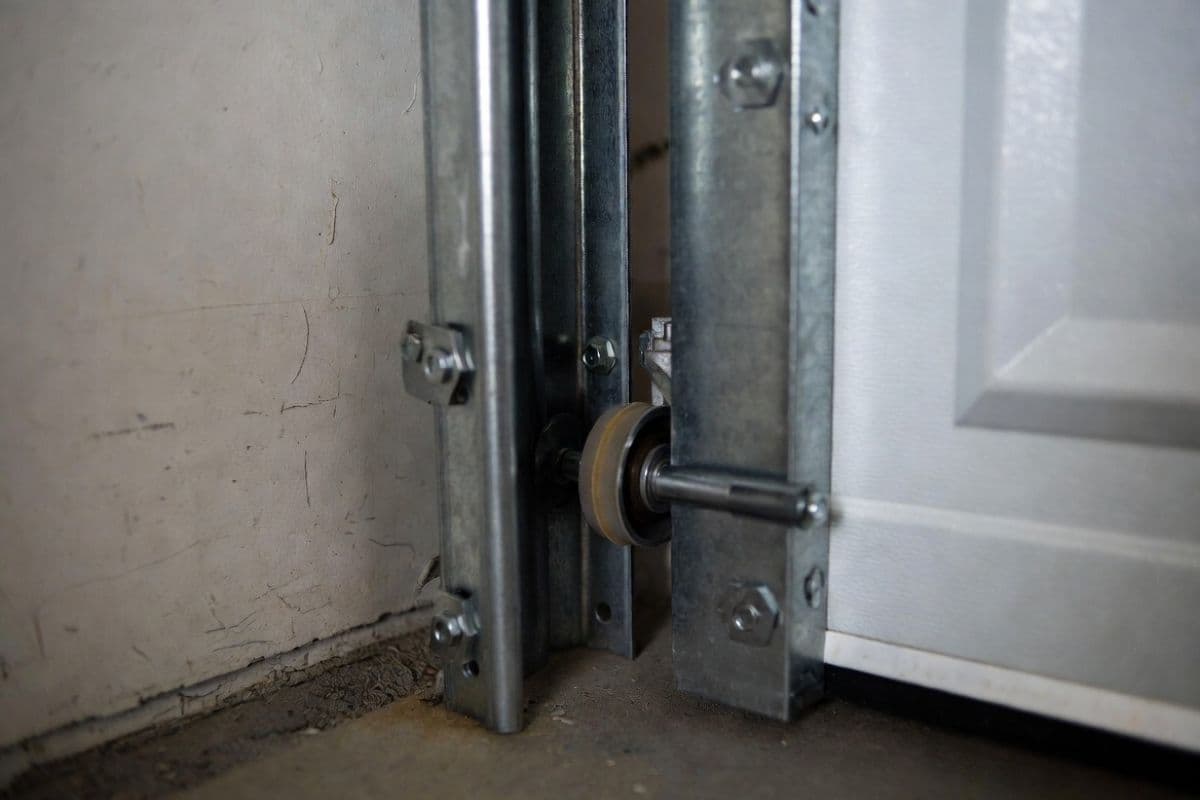
The named diagnostic for an off-track garage door is The Gap Test. Stand in front of the door and look at both tracks. You are looking for one specific thing: where are the rollers relative to the track channel?
A roller that has jumped the track leaves a visible gap between the roller wheel and the track wall. The door panel sags or tilts toward the side where the roller came out. Once you find the gap, you know which roller came out first and where the problem originated.
After locating the gap, check these five things in order:
1. Roller condition: Is the roller wheel cracked, broken, or missing entirely? A visibly damaged roller needs replacement, not just reinsertion.
2. Track condition: Is the track straight? Look down its length from below. A bent or dented section of track will not hold a roller no matter how carefully you reinsert it.
3. Cable condition: Look at the lift cables on each side of the door. They should be taut and wound properly on the drum above. A cable that is frayed, snapped, or hanging loose means the door is unbalanced and unsafe to touch until a professional replaces the cable. A broken lift cable is one of the most common causes of a door coming off track. If the cable has snapped or gone slack, see our garage door cable broke guide for immediate steps and repair costs.
4. Spring condition: Look at the torsion spring above the door or the extension springs along the horizontal tracks. A broken spring is obvious: either the coil is separated or one side of the door sags heavily while the other side appears normal. Broken spring means call a pro immediately. A broken torsion spring can also cause the door to derail by creating uneven weight distribution. See our garage door spring replacement guide for what that repair involves.
5. Track mounting: Are the track brackets still bolted to the wall? A track that has pulled away from the wall will swing outward and allow rollers to escape repeatedly until the mounting is repaired.
Cause Diagnosis Table
| What You See | Most Likely Cause | DIY or Pro |
|---|---|---|
| One roller out, track straight, no cable or spring damage | Roller slipped out from minor impact or wear | DIY possible |
| Multiple rollers out, door crooked | Impact damage or broken cable | Pro |
| Visible dent or bend in track | Impact or worn track | Pro if severe, DIY if minor |
| Cable hanging loose or frayed | Broken lift cable | Pro immediately |
| Door sags heavily on one side | Broken spring or broken cable | Pro immediately |
| Track pulled away from wall | Loose or failed track mounting brackets | DIY if bolts only, Pro if wall damage |
| Grinding noise before derailment | Worn rollers or debris in track | DIY possible after clearing debris |
| Door stopped mid-travel with opener straining | Obstruction in track or roller seized in track | DIY possible |
What You Can Fix Yourself
Only attempt DIY if:
- One or two rollers have come out
- The track is straight with no bends or dents
- Both lift cables are intact and taut
- Both springs are intact
- The door is not hanging at a severe angle
Tools you need:
- Locking pliers (two pairs)
- Flathead screwdriver
- Adjustable wrench
- Rubber mallet
- Work gloves
- Safety glasses
Step-by-Step: Re-engaging a Derailed Roller
Step 1: Secure the door. Confirm locking pliers are clamped on the track below the lowest roller on both sides. The door must not be able to move.
Step 2: Locate the derailed roller. Find the specific roller or rollers that have come out of the track. The door will sag toward that side.
Step 3: Open the track flange. Use a flathead screwdriver to gently pry the lip of the track open just enough to allow the roller wheel to slip back inside. You are not bending the track significantly, just creating enough clearance for the wheel. Work slowly.
Step 4: Guide the roller back in. With one hand holding the track open slightly, use your other hand to guide the roller wheel back into the track channel. The stem of the roller connects to the door hinge and should not move. You are only repositioning the wheel.
Step 5: Close the track flange. Use a rubber mallet to gently tap the track flange back to its original position. The roller should now sit inside the track channel with minimal play.
Step 6: Repeat for any additional derailed rollers. Work one roller at a time. Do not remove the locking pliers until all rollers are back in the track.
Step 7: Test manually. With locking pliers still on the track as a safety stop, try to move the door by hand a few inches. It should move smoothly without grinding or binding. If it binds, stop and reassess. Do not force it.
Step 8: Remove locking pliers and test. Once the door moves smoothly by hand, remove the locking pliers. Reconnect the opener by pulling the emergency release cord until it clicks back into the carriage. Test the opener at slow speed. Watch both sides of the door as it travels.
What Requires a Professional
Do not attempt to fix any of the following yourself:
Broken torsion spring: The torsion spring above the door stores enormous energy equivalent to lifting the full weight of the door. A broken spring that releases unexpectedly causes severe injury. Spring replacement is the single most dangerous DIY garage door repair. A professional has the winding bars, safety equipment, and experience to handle it safely. See our garage door spring replacement guide for what the professional process involves.
Broken or frayed lift cable: Lift cables balance the weight of the door across both sides. A broken cable means the door is unbalanced and under uneven stress. Attempting to open a door with a broken cable can cause the opposite cable to snap under the extra load, dropping the door suddenly.
Severely bent track: A track with a significant dent or bend will cause rollers to derail repeatedly regardless of how carefully they are reinserted. Track replacement requires removing the door panels, which requires spring tension to be released first.
Multiple derailed rollers with door crooked: A door hanging at a steep angle has already redistributed its weight unevenly. Attempting to force it back into alignment without first understanding why multiple rollers came out simultaneously is dangerous.
Damaged door panels affecting alignment: If a vehicle impact bent a door panel, the panel itself may be distorted enough to prevent the door from tracking correctly even after the rollers are reinserted.
Repair vs Replace Decision Table
| Situation | Repair Cost | Replacement Cost | Recommendation |
|---|---|---|---|
| Roller reinserted, track intact | $0 DIY or $75–$150 pro | N/A | DIY if minor |
| 1 to 2 worn rollers replaced | $100–$200 | N/A | Pro repair |
| Full roller replacement (all rollers) | $150–$300 | N/A | Pro repair |
| Single track section replaced | $150–$250 | N/A | Pro repair |
| Both tracks replaced | $200–$400 | N/A | Pro repair |
| Broken torsion spring plus track repair | $300–$600 | N/A | Pro repair |
| Broken cable plus track repair | $200–$400 | N/A | Pro repair |
| Door older than 15 years with multiple issues | $400–$800 | $700–$1,500 | Consider replacement |
For severely damaged doors where panel replacement is no longer cost-effective, use our garage door replacement cost calculator to estimate the full replacement project.
Emergency Situation: Door Is Stuck Open
A garage door stuck in the open position due to coming off track is a security emergency. Your home is exposed until the door is repaired or secured. If a technician cannot respond same-day:
- Do not leave the home unattended with the door open
- Contact a 24-hour garage door service. Most major companies offer emergency response
- As a temporary measure, you can manually lower the door if it is safe to do so with the opener disconnected, and wedge it in place. This is not a secure solution and should only be used for a few hours at most
If you are unable to close the door at all, see our garage door won't close guide for additional approaches. Emergency repair services: Most garage door companies charge $150 to $300 for emergency or after-hours service calls. The repair itself is billed separately. Get the door operational before worrying about negotiating the price.
What Caused This and How to Prevent It
Once the door is back on track, understand what caused it to come off. Without addressing the root cause, it will happen again.
Vehicle impact: The most common cause. Even a slow collision with the door bottom panel while backing out of the garage can bend the track or knock rollers out. If this happened, inspect the entire bottom section of both tracks for dents before pronouncing the repair complete.
Worn rollers: Garage door rollers last 10 to 15 years with proper lubrication. Nylon rollers last longer than steel rollers and run more quietly. If the rollers are visibly worn, cracked, or more than 10 years old, replace all of them at the same time rather than one at a time.
Loose track mounting hardware: Every time the door cycles, the vibration loosens the bolts holding the track brackets to the wall slightly. These bolts should be tightened during annual maintenance. If the track pulled away from the wall, the bolts were overdue.
Broken spring or cable as the root cause: If a spring or cable broke and caused the door to come off track, simply reinserting the rollers does not fix the underlying problem. The spring or cable must be repaired first, or the door will come off track again on the first use.
Debris in the track: Dirt, leaves, or small objects in the track channel cause rollers to bind and eventually jump out. Clean tracks with a damp cloth and apply a silicone-based lubricant to the rollers and hinges every six months. Never use WD-40 on garage door tracks. It attracts dust and gums up over time.
For a complete seasonal maintenance schedule that prevents off-track issues, see our garage door maintenance guide.
For additional safety information, see the U.S. Consumer Product Safety Commission: Automatic Residential Garage Door Operators.
Frequently Asked Questions
Is a garage door off track dangerous?
Yes. A garage door weighs 130 to 350 pounds and operates under significant spring tension. A door that has come off track is no longer controlled by its guidance system and can drop, swing, or shift unexpectedly. Do not attempt to operate a door that is off track with the opener. Disconnect the opener immediately, secure the door with locking pliers, and assess the situation before touching anything else.
Can I put a garage door back on track myself?
Only in limited circumstances. If a single roller has slipped out, the track is straight with no bends, both lift cables are intact, and the springs are not broken, a careful homeowner with basic tools can guide the roller back into the track. If any of those conditions are not met (bent track, broken cable, broken spring, or multiple rollers out), the repair requires a professional. Attempting to force a door back into alignment when a spring or cable is broken can cause the door to drop suddenly.
How much does it cost to fix a garage door off track?
A minor roller re-engagement by a professional costs $75 to $150 for the service call. Roller replacement costs $100 to $300 depending on how many rollers need replacement. Track replacement runs $150 to $400 depending on whether one or both tracks need work. If the off-track situation was caused by a broken spring or cable, add $150 to $350 for the spring or cable repair. Total repairs for a typical off-track situation run $150 to $500 professionally.
What causes a garage door to keep coming off track?
Repeated derailment almost always points to one of three root causes: worn rollers that no longer fit properly in the track channel, a bent or damaged section of track that causes rollers to jump out at the same spot each time, or loose track mounting hardware that allows the track to flex away from the wall during operation. Reinserting the rollers without fixing the root cause will result in the same problem recurring within days or weeks.
How long does a garage door off track repair take?
A minor roller re-engagement takes 30 to 60 minutes for a professional. A more involved repair including roller replacement and track adjustment takes 1 to 2 hours. Track replacement takes 2 to 3 hours. If the repair requires spring replacement as well, add another 30 to 60 minutes. Most off-track repairs are completed in a single service visit.
Should I use the opener on a garage door that is off track?
No. Disconnect the opener using the red emergency release cord before doing anything else. An opener running against a door that is off track can strip the opener motor, bend the door further, damage the track, and in severe cases cause the door to fall. The opener is designed to move a door that is properly guided by its track. It is not designed to force a misaligned door.
What is the red cord hanging from my garage door opener?
The red emergency release cord disconnects the garage door from the opener carriage, allowing the door to be operated manually. Pulling it disengages a trolley mechanism and lets the door move freely by hand. It is designed for use during power outages and emergency situations including when the door has come off track. Always pull this cord before working on a garage door that has come off track, even if the opener is not running.
Can a bent garage door track be repaired or does it need replacement?
Minor dents in a garage door track can sometimes be tapped back into shape with a rubber mallet without affecting roller movement. Significant bends, crimps, or sections where the track profile is distorted require track section replacement. A track that has been repaired once in the same location should be monitored closely. The metal is weakened at that point and may fail again. If a track has been repaired more than once, replacement is the more reliable long-term solution.
Related Guides
Garage Door Spring Replacement
What the professional repair process involves and when to replace vs repair.
ProblemGarage Door Won't Open
If the opener runs but the door does not move.
ProblemGarage Door Won't Close
Related issues that can accompany an off-track door.
GuideGarage Door Maintenance
The seasonal inspection schedule that prevents off-track issues.
ProblemGarage Door Opener Not Working
If the opener itself failed during or after the off-track event.
Glossary
Torsion spring
The large coiled spring mounted horizontally above the garage door opening that stores mechanical energy to counterbalance the weight of the door. When wound correctly, a torsion spring makes a 130 to 350-pound door feel nearly weightless to lift by hand. Torsion springs have a finite cycle life, typically 10,000 cycles, and must be replaced by a professional when they break due to the extreme stored energy they contain.
Lift cable
The steel cable that connects the bottom bracket of the garage door to the spring drum above the door. Lift cables transfer the energy stored in the torsion spring to the door, keeping it balanced during operation. One cable runs on each side. If one cable breaks, the door becomes severely unbalanced and unsafe to operate.
Roller
The wheeled component that fits into the track and allows the door to travel up and down. Garage door rollers have a wheel, a stem, and a bearing. The wheel rides inside the track channel. Nylon rollers with sealed bearings are quieter and longer-lasting than standard steel rollers. Most residential doors have 10 to 12 rollers. Rollers typically last 10 to 15 years with proper lubrication.
Track
The metal channel, typically galvanized steel, that guides the rollers and controls the path of the garage door from the closed position on the vertical section to the open position on the horizontal section. Tracks are mounted to the wall and ceiling with brackets and lag bolts. Standard residential track gauge is 2-inch for single-car doors and 3-inch for heavier two-car doors.
Emergency release cord
The red rope hanging from the opener carriage that disconnects the door from the opener motor when pulled. Allows the door to be operated manually in the event of power failure or mechanical problem. Should be the first thing you pull when a garage door comes off track. Can be re-engaged by pulling the cord toward the opener until it clicks back into the carriage.
Carriage
The trolley assembly that travels along the opener rail and connects to the door via the emergency release mechanism. When the emergency release cord is pulled, the carriage decouples from the door, allowing independent movement. When reconnected, the opener motor drives the carriage which pulls or pushes the door.
Track flange
The curved lip at the open edge of the track channel that holds the roller wheel inside the track. Can be gently pried open with a screwdriver to allow a derailed roller wheel to be reinserted. Should be tapped back to its original profile with a rubber mallet after the roller is re-engaged.
Hinge
The metal bracket that connects adjacent door panels and holds the roller stem in place. Hinges are numbered by position: bottom hinges (No. 1) are the lightest and top hinges (No. 3 or No. 4) are the heaviest. A bent or cracked hinge can cause the roller stem to shift out of alignment, contributing to rollers jumping the track. Hinges should be inspected during annual maintenance and replaced if cracked or visibly distorted.
Bottom bracket
The metal bracket at the bottom corner of each garage door panel that anchors the lift cable. Bottom brackets are under significant tension when the door is in the closed position because the spring tension is applied through the cable attached here. Never attempt to remove or modify a bottom bracket without first releasing spring tension.