Updated Mar 2026 · 14 min read
Garage Ventilation Guide
Carbon monoxide safety, CFM calculations, and the right fan for every garage.
Quick answer: Proper garage ventilation requires addressing three distinct needs: safety ventilation to remove carbon monoxide and vehicle exhaust, thermal ventilation to manage summer heat, and workshop ventilation for paint fumes, solvents, and sawdust. For an attached garage, the EPA recommends a minimum exhaust fan capacity of 70 CFM running continuously or activated by motion. A standard 2-car attached garage (576 square feet) requires approximately 480 CFM of exhaust capacity for general use or 770 CFM for workshop activities. Carbon monoxide detectors must be placed in the living space adjacent to the garage — not in the garage itself. Never run a vehicle engine in a closed garage, even with the door open a few inches.
Why Garage Ventilation Is Primarily a Safety Issue
Most homeowners think about garage ventilation as a comfort issue — keeping the garage cool in summer or reducing that stale, musty smell. Comfort is a secondary benefit. The primary reason garage ventilation matters is safety.
An attached garage is one of the most dangerous rooms in a home from an air quality standpoint. It concentrates three categories of serious hazards in a single enclosed space:
Carbon monoxide from vehicle exhaust. CO is colorless, odorless, and lethal at surprisingly low concentrations. A single running vehicle in a typical attached garage can raise CO levels to dangerous concentrations within minutes. CO is heavier than oxygen but distributes throughout a space quickly; it does not stay near the floor as many people mistakenly believe.
Chemical vapors from stored materials. Most homeowners store gasoline (for lawn equipment and snowblowers), motor oil, paint, paint thinner, pesticides, and cleaning solvents in the garage. Many of these materials off-gas continuously, and most produce vapors that are heavier than air, accumulate at floor level, and are flammable.
Workshop fumes and particulates. Homeowners who use the garage as a workshop generate sawdust, paint mist, solvent vapors, and in some cases welding fumes — each with specific ventilation requirements significantly higher than those for a parking-only garage.
For attached garages, inadequate ventilation creates a direct pathway for all three hazard types to enter the living space through shared walls, ceiling penetrations, and the door between the garage and house.
The Attached vs. Detached Distinction
Ventilation requirements and solutions differ significantly between attached and detached garages.
Attached garage: Shares at least one wall with the living space. Any air quality problem in the garage has a direct pathway to the home. CO and chemical vapors can migrate through gaps in the fire separation wall, around the door between the garage and house, through shared HVAC ductwork if present, and through any penetration in the shared wall assembly. Attached garages require both adequate ventilation and proper air sealing of the shared wall to prevent contaminant transfer.
Detached garage: Fully independent structure with no shared walls. Air quality problems in the garage do not directly threaten the home's air quality. Ventilation requirements are still real — CO from a running engine in a closed detached garage is just as dangerous to anyone inside — but the risk of contaminant transfer to the living space does not exist.
The critical interaction between ventilation and air sealing for attached garages: A well-ventilated attached garage that has poor air sealing on the shared wall can actually spread contaminants more effectively than a poorly ventilated one, because the exhaust fan creates negative pressure that draws air into the garage from the living space, and air then travels back through gaps under a pressure differential. Ventilation and air sealing of the shared wall must be addressed together, not separately. See the complete garage guide for the fire separation and air sealing requirements that complement proper ventilation.
The Depressurization Problem: Why Ventilation Alone Is Not Enough
This is the most important concept in this guide that most homeowners never encounter.
When an exhaust fan removes air from the garage, it creates negative pressure inside the garage relative to the outside. The garage needs to draw replacement air from somewhere. In a well-sealed garage, that air comes through deliberate intake vents from outside. In a poorly sealed attached garage, some of that makeup air can come from the living space through gaps around the door, cracks in the shared wall, electrical outlet boxes, and pipe penetrations.
Now consider the home itself. Many appliances depressurize the living space: range hoods, bathroom exhaust fans, clothes dryers, and central vacuum systems all exhaust air from the home. When these appliances run, the home interior goes slightly negative relative to the garage. Under those conditions, air flows from the garage into the home through every gap in the shared wall, regardless of whether the garage exhaust fan is running.
The EPA Building America program specifically identifies this dynamic as one of the primary pathways for garage pollutants to enter living spaces. Their recommendation addresses both sides: exhaust the garage mechanically, and thoroughly air-seal the shared wall between the garage and living space. Caulk around outlet boxes, seal pipe penetrations with fire-rated foam, install weatherstripping on the door between the garage and house, and confirm that the door is self-closing and self-latching.
A garage exhaust fan without air sealing of the shared wall provides incomplete protection. Both are required.
The Carbon Monoxide Danger: Numbers Every Garage Owner Needs to Know
CO poisoning in residential garages kills people every year. Understanding the specific concentrations and timeframes involved explains why the safety margins matter.
CO concentration reference levels:
| CO Level (PPM) | Effect | Source |
|---|---|---|
| 9 ppm | ASHRAE recommended maximum for enclosed parking, 8-hour average | ASHRAE 62.1 |
| 35 ppm | OSHA permissible exposure limit, 8-hour time-weighted average | OSHA |
| 70 ppm | Headache, fatigue, nausea after 2 to 3 hours of exposure | CDC |
| 150 to 200 ppm | Headache, dizziness, disorientation within 2 to 3 hours | CDC |
| 400 ppm | Life-threatening after 3 hours | CDC |
| 800 ppm | Dizziness, nausea, convulsions within 45 minutes; death within 2 to 3 hours | CDC |
| 1,200 ppm | Immediate physiological effect; death within 1 hour | OSHA IDLH |
| 6,400 ppm | Death within 10 to 15 minutes | CDC |
How quickly does a running vehicle raise CO levels?
A single modern gasoline vehicle running in a typical 2-car attached garage (576 square feet, 8-foot ceiling, 4,608 cubic feet of volume) can raise CO concentrations to 200 ppm in as little as 3 to 5 minutes of idling. Older vehicles, cold starts, and high-performance engines reach dangerous levels faster. The concentration continues to build as long as the engine runs.
The “crack the door open” myth
Many homeowners believe that opening the garage door 6 to 12 inches while warming up a vehicle provides sufficient ventilation. It does not. At a small opening, the natural airflow is insufficient to dilute CO production from a running engine at the rate needed to stay below dangerous concentrations. Tests consistently show that partially opening the garage door while a vehicle runs still allows CO to accumulate to dangerous levels within minutes. The garage door must be fully open — and even then, the vehicle should not run inside the garage for extended periods.
Never run a vehicle engine inside a garage with the garage door closed, even for a few minutes. If warming up the vehicle is necessary in cold weather, back it out of the garage before starting the engine.
CO Detector Placement: The Rule Most Homeowners Get Wrong
CO detectors must be placed in the living space adjacent to the attached garage, not in the garage itself.
This is counterintuitive but important. CO detectors use electrochemical sensors that can be damaged or give inaccurate readings when exposed to the temperature extremes typical of an unheated garage — below 40°F in winter or above 95°F in summer. A detector placed in a garage may malfunction in the conditions it is most needed.
The CPSC recommends placing CO detectors on every level of the home and outside each sleeping area. For a home with an attached garage, this means at minimum a detector in the hallway or room immediately adjacent to the garage, at sleeping level (approximately 5 feet off the floor).
A detector in the garage is not a substitute for proper ventilation and air sealing. The detector alerts occupants after CO has already entered the living space. Ventilation and air sealing prevent it from entering in the first place.
Ventilation Codes and Requirements
Understanding what codes require — and what they do not require — helps homeowners make informed decisions.
International Residential Code (IRC): The IRC, which governs one- and two-family dwellings in most US jurisdictions, does not mandate mechanical ventilation for residential attached garages. It requires that openable area to the outdoors be not less than 4 percent of the garage floor area for natural ventilation purposes. Most residential garages meet this with the garage door and any windows. The IRC does not require a powered exhaust fan in a residential garage.
International Mechanical Code (IMC): The IMC, which governs commercial and multi-family applications, requires mechanical ventilation for enclosed parking garages at 0.75 CFM per square foot of floor area, either continuously or automatically controlled by CO detectors. This standard is most relevant for commercial parking structures but provides a useful benchmark for residential applications.
EPA recommendation for attached garages: The EPA's Building America program specifically recommends a minimum 70 CFM exhaust fan for attached residential garages, wired for continuous operation or activated by a motion detector that runs the fan for at least one hour after the garage is vacated. This is a recommendation rather than a code requirement but represents current best practice.
The practical takeaway: Most residential garages are not required by code to have a mechanical exhaust fan. But code compliance and safety are not the same thing. The absence of a code requirement does not mean a garage is safe without mechanical ventilation — it means the code has not caught up to the safety evidence. A powered exhaust fan in any attached garage is a meaningful safety improvement.
How to Calculate the CFM You Need
CFM (cubic feet per minute) is the measure of airflow used to size ventilation equipment. The calculation is straightforward.
The CFM formula:
CFM = (Garage Volume in cubic feet × Air Changes Per Hour) ÷ 60
Garage Volume = Length × Width × Ceiling Height
Air Changes Per Hour (ACH) by use:
| Garage Use | Recommended ACH | Notes |
|---|---|---|
| General storage and parking | 6 to 8 ACH | Baseline safety ventilation |
| Active workshop (woodworking, light metalwork) | 10 to 15 ACH | Dust and light fumes |
| Spray painting | 15 to 20 ACH | Requires explosion-proof fan |
| Welding | 20+ ACH | Local exhaust ventilation recommended |
Worked example — standard 2-car attached garage:
- Dimensions: 24 × 24 feet with 8-foot ceiling
- Volume: 24 × 24 × 8 = 4,608 cubic feet
- General parking use (6 ACH): (4,608 × 6) / 60 = 461 CFM
- Workshop use (10 ACH): (4,608 × 10) / 60 = 768 CFM
For a standard 2-car attached garage used for parking and occasional light work, a single exhaust fan rated at 500 to 600 CFM provides adequate general ventilation. For regular workshop use, two fans or one high-capacity fan providing 700 to 800 CFM is appropriate.
Sizing up: Always round up to the next available fan size. A fan running at 75 percent of its rated capacity lasts significantly longer and runs quieter than one running at full capacity continuously.
Pre-calculated CFM reference by garage size and use:
| Garage Size | Dimensions | Volume | General Use (6 ACH) | Workshop (10 ACH) | Spray Painting (15 ACH) |
|---|---|---|---|---|---|
| 1-car standard | 12 × 20 ft | 1,920 cu ft | 192 CFM | 320 CFM | 480 CFM |
| 1-car full | 14 × 24 ft | 2,688 cu ft | 269 CFM | 448 CFM | 672 CFM |
| 2-car standard | 20 × 20 ft | 3,200 cu ft | 320 CFM | 533 CFM | 800 CFM |
| 2-car full | 24 × 24 ft | 4,608 cu ft | 461 CFM | 768 CFM | 1,152 CFM |
| 3-car standard | 30 × 22 ft | 5,280 cu ft | 528 CFM | 880 CFM | 1,320 CFM |
| 3-car full | 36 × 24 ft | 6,912 cu ft | 691 CFM | 1,152 CFM | 1,728 CFM |
All calculations assume 8-foot ceiling height. For 9-foot ceilings multiply by 1.125. For 10-foot ceilings multiply by 1.25. Spray painting column assumes explosion-proof fan required.
Section 1: Safety Ventilation for Carbon Monoxide
Safety ventilation is the minimum ventilation every attached garage should have regardless of how the garage is used.
The Exhaust Fan
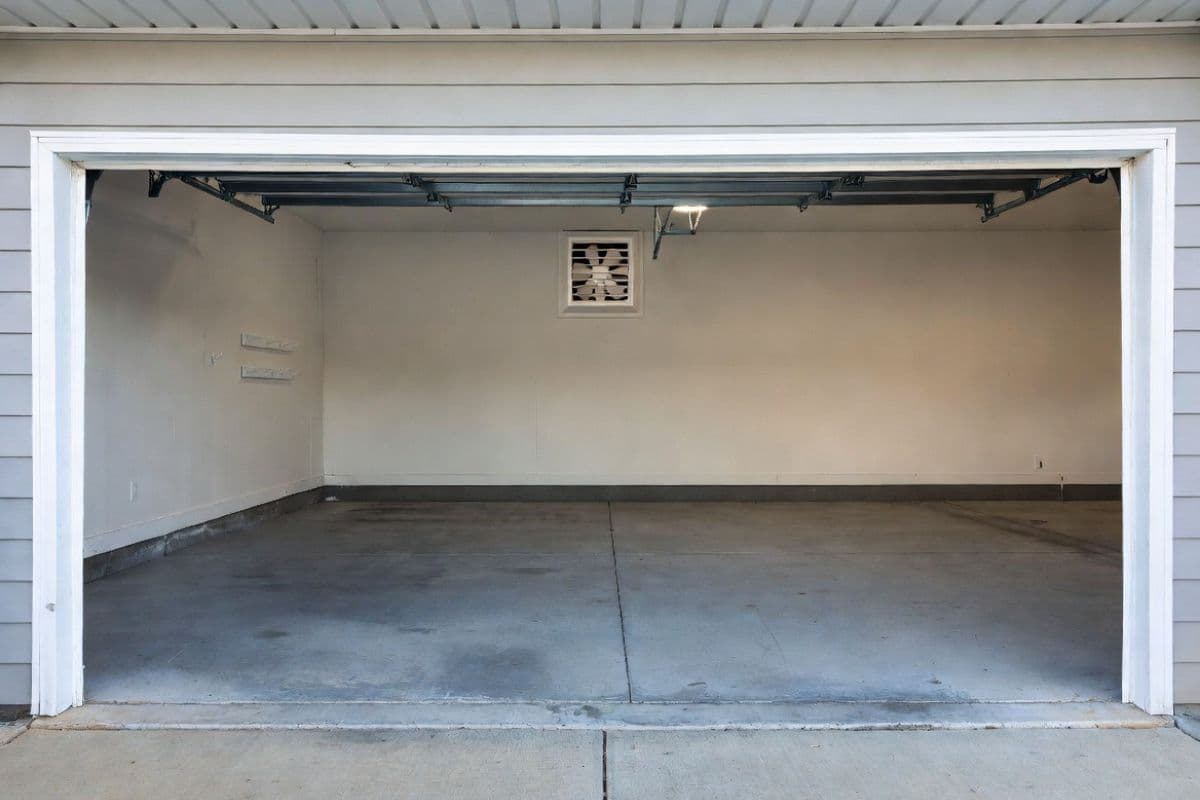
A wall-mounted exhaust fan positioned high on the wall opposite the garage door opening is the standard solution for safety ventilation in a residential attached garage. Positioning the fan high removes the warm, contaminated air that rises after collecting near the floor (CO distributes evenly, but heat carries it upward). Mounting it on the wall opposite the door creates a cross-ventilation path when the garage door is open.
Fan placement: Mount the exhaust fan as high as possible on an exterior wall, ideally within 12 inches of the ceiling. Do not mount the exhaust fan on the shared wall between the garage and the living space — this would exhaust air toward the house rather than away from it.
Minimum specification: 70 CFM for a 1-car garage. 500 to 600 CFM for a standard 2-car garage. Fan must be rated for garage use (moisture and temperature resistant).
Wiring options:
- Switched: Manually operated. Simple to install but relies on the occupant to turn it on.
- Motion-activated: Turns on when the garage is occupied and runs for a programmed period (typically 30 to 60 minutes) after the last motion is detected. The EPA specifically recommends this configuration for attached garages.
- Continuously wired: Runs 24/7. Maximum protection at higher operating cost.
Cost: Wall exhaust fans appropriate for garage ventilation range from $80 to $300 for the unit. Professional installation adds $150 to $400.
Passive Intake Vents
An exhaust fan removes air from the garage, creating negative pressure that must be equalized by drawing air in from somewhere. Without an intake path, the fan works against resistance and moves less air than its rated CFM.
For attached garages, intake air should come from the outside — not from the living space. Install a louvered intake vent on an exterior wall near the floor (lower on the wall than the exhaust fan, to create a diagonal airflow path through the garage) or rely on the garage door and any windows for makeup air when the garage is in use.
Do not create intake openings in the shared wall between the garage and the living space. These would allow garage air to enter the house under pressure from the exhaust fan.
Section 2: Thermal Ventilation for Summer Heat
An unventilated garage in a hot climate can reach 120 to 140°F on a summer afternoon. This heat transfers into the adjacent living space through the shared wall, increases cooling loads, and makes the garage unusable for any activity. See the garage too hot in summer guide for the complete thermal comfort strategy.
The Insulation-First Rule
Before investing in thermal ventilation equipment, evaluate the garage's insulation. An uninsulated garage door and uninsulated shared wall are the two largest sources of heat gain in most garages. Insulating the garage door ($200 to $600 for an insulated replacement door or $50 to $150 for a retrofit kit) and the shared wall (R-13 to R-21 depending on climate zone) reduces heat gain far more cost-effectively than any fan system.
The test: In a hot climate on a summer afternoon, open the garage door fully for 20 minutes and note whether the temperature drops significantly. If it does, natural ventilation through the door is the primary heat pathway and insulation is the higher-priority improvement. If the temperature stays high despite the open door, radiant heat from the roof is the main source and attic ventilation or roof insulation needs to be addressed.
See the how to insulate your garage guide for the complete insulation approach by component.
Ventilation Solutions for Summer Heat
Gable vent fans: Installed in the gable end of a garage with an attic space, these fans pull hot air out of the attic above the garage rather than the garage itself, reducing radiant heat transfer downward. Effective and relatively inexpensive ($100 to $300 installed).
Whole-garage exhaust fans: A high-CFM exhaust fan (800 to 1,200 CFM for a 2-car garage) running when the garage is in use flushes out accumulated hot air and pulls in cooler outside air. Most effective in climates where outside air temperature is below garage temperature, which is most of the day except in extreme climates.
Ceiling fans: A garage ceiling fan does not lower the air temperature but reduces the perceived temperature by 3 to 8 degrees through evaporative cooling. Cost-effective at $50 to $200 for a standard garage ceiling fan.
Mini-split system: For garages used as conditioned workshops, gyms, or hobby spaces, a mini-split provides genuine cooling as well as heating, maintaining a comfortable temperature regardless of outdoor conditions. Cost $1,500 to $4,000 installed. See the garage heater guide for the full HVAC options comparison.
Section 3: Workshop Ventilation
A garage used as a workshop generates contaminants that general parking ventilation cannot adequately address. The type of work determines the ventilation requirements.
Woodworking and General Fabrication
Fine wood dust is both a respiratory hazard and a fire hazard at high concentrations. General dilution ventilation — exhausting garage air at 10 to 15 ACH — reduces airborne dust concentration for general woodworking. For serious woodworking, a dedicated dust collection system that captures dust at the source is significantly more effective than dilution ventilation alone and should be the primary dust control strategy, with general ventilation providing backup.
Paint and Solvent Work
This is the highest-risk workshop category and requires the most attention.
Paint fumes, lacquer thinners, mineral spirits, and similar solvents produce vapors that are both toxic and flammable. Standard exhaust fans with steel motors can produce sparks from the motor brushes or electrical contacts that can ignite solvent vapors. For any work involving spray painting, lacquer application, or heavy solvent use, the exhaust fan must be explosion-proof (also called spark-proof or sparkless) — a fan design where the motor is sealed and all electrical contacts are isolated from the airstream.
Never use a standard household or garage exhaust fan for spray painting. The risk of igniting solvent vapors with a standard fan motor is genuine and documented.
ACH requirements for spray painting: 15 to 20 ACH minimum. For the standard 2-car garage example above (4,608 cubic feet), this requires 1,152 to 1,536 CFM of exhaust capacity from an explosion-proof fan.
Spray painting also requires makeup air. Exhausting at 1,500 CFM without adequate intake creates strong negative pressure that causes uneven spray patterns, pulls coating back toward the painter, and may cause door seals to fail. Provide a filtered intake equal to the exhaust volume.
Welding
Welding produces metal fumes, ozone, and nitrogen oxides — contaminants that are toxic at low concentrations and require direct capture ventilation rather than dilution alone. OSHA recommends local exhaust ventilation (a capture hood positioned close to the welding arc) as the primary control, supplemented by general dilution ventilation of 20+ ACH. A general garage exhaust fan is not an adequate substitute for local exhaust ventilation in a welding environment.
Ventilation Solutions Summary
| Solution | Best For | CFM Range | Cost Range | Notes |
|---|---|---|---|---|
| Passive louvered vents | Minimal natural ventilation | N/A | $30 to $100 | No fan, limited effectiveness |
| Single wall exhaust fan | Safety ventilation, small garage | 70 to 300 CFM | $80 to $400 installed | Minimum recommended for attached garage |
| Dual wall exhaust fans | 2-car garage, general use | 500 to 800 CFM | $300 to $800 installed | Standard recommendation |
| High-CFM wall fan | Workshop, heavy use | 800 to 1,500 CFM | $400 to $1,000 installed | For active workshop use |
| Explosion-proof exhaust fan | Spray painting, solvent work | 1,000 to 2,000 CFM | $500 to $1,500 installed | Required for flammable vapor environments |
| Gable attic fan | Thermal ventilation, heat reduction | 1,000 to 1,500 CFM | $200 to $600 installed | Reduces radiant heat from above |
| Ceiling fan | Comfort, perceived cooling | N/A | $80 to $300 installed | No air exchange, comfort only |
| Mini-split system | Year-round conditioned workshop | N/A (HVAC) | $1,500 to $4,000 installed | Both heating and cooling |
EV Charging and Ventilation
A fully electric vehicle (BEV) produces no engine exhaust during normal operation, which eliminates the CO risk from starting and parking. However, EV ownership does not eliminate the need for garage ventilation entirely.
A lithium-ion battery fire — caused by a manufacturing defect, physical damage, or thermal runaway during charging — produces toxic gases including hydrogen fluoride, carbon monoxide, and other combustion products. These fires are rare but severe, and they require adequate ventilation to manage the air quality hazard if they occur. The NFPA recommends garages with EV charging stations be provided with mechanical ventilation.
For households with a Level 2 EV charger in an attached garage, maintaining adequate general ventilation (the same 500 to 600 CFM exhaust fan recommended for any attached garage) is appropriate. Do not store an EV in an attached garage without the fire separation requirements covered in the complete garage guide being met. See the EV charger installation guide for the complete EV charging setup in a residential garage.
If You Just Bought a Home With an Attached Garage: Do These Five Things First
New homeowners with an attached garage often have no idea what ventilation infrastructure, if any, the previous owner put in place. These five checks take less than 30 minutes and establish your baseline.
- 1
Check for an exhaust fan. Look on the exterior walls of the garage for a louvered fan housing or vent. If there is no exhaust fan, adding one is the highest-priority ventilation improvement you can make. A 500 to 600 CFM wall exhaust fan installed by an electrician costs $300 to $600 all-in.
- 2
Find your CO detector. It should be in the living space adjacent to the garage — in the hallway, room, or stairwell nearest the garage — at approximately 5 feet off the floor. If there is a CO detector inside the garage, it is in the wrong location. If there is no CO detector adjacent to the garage at all, install one before using the garage for any purpose.
- 3
Check the door between the garage and the house. Open it and let it go. It should close and latch by itself. If it stays open or does not latch, the self-closing mechanism needs adjustment or replacement. Check whether it is a solid-core door — tap it in the middle. Solid-core sounds dull and heavy. Hollow-core sounds hollow. If it is hollow-core, it does not meet fire separation requirements and should be replaced.
- 4
Check the shared wall for obvious gaps. Look at the wall between the garage and the living space from the garage side. Any open gaps around pipes, wires, or outlet boxes are pathways for CO and chemical vapors to enter the home. Seal them with fire-rated caulk or foam.
- 5
Note the surface drainage around the garage floor. If the garage floor has a drain, find out where it connects before washing down the floor or disposing of any liquids. See the complete garage guide for the floor drain discharge question every new garage owner should answer.
Frequently Asked Questions
Does a garage need ventilation?
Yes, particularly an attached garage. An attached garage concentrates three serious air quality hazards — carbon monoxide from vehicle exhaust, chemical vapors from stored materials, and workshop fumes — in a space that shares walls with the living area. The IRC does not mandate mechanical ventilation for residential attached garages, but the EPA recommends a minimum 70 CFM exhaust fan running continuously or activated by motion. Any garage used for workshop activities requires higher ventilation capacity. A garage with no ventilation is not code-violating in most jurisdictions, but it is a genuine safety risk.
How many CFM do I need to ventilate my garage?
The formula is: CFM = (Garage volume in cubic feet × Air Changes Per Hour) ÷ 60. For general parking use, plan for 6 to 8 air changes per hour. For workshop use, plan for 10 to 15 ACH. For spray painting, plan for 15 to 20 ACH. A standard 2-car garage (576 square feet with 8-foot ceilings) has a volume of 4,608 cubic feet and needs approximately 460 to 615 CFM for general use and 770 to 1,150 CFM for active workshop activities.
Where should a CO detector be placed for an attached garage?
In the living space adjacent to the garage, not in the garage itself. CO detectors use electrochemical sensors that can be damaged by the temperature extremes typical of an unheated garage. Place the detector at sleeping level (approximately 5 feet off the floor) in the nearest bedroom or hallway to the garage. The CPSC recommends CO detectors outside each sleeping area and on every level of the home. A detector in the garage is not a substitute for one in the adjacent living space.
Is it safe to run a car in the garage with the door open?
Only if the door is fully open and the vehicle is running briefly. Running a vehicle with the door open a few inches is not safe — the partial opening does not provide sufficient airflow to prevent CO from accumulating to dangerous levels. Even with the door fully open, a vehicle should not idle inside an attached garage for extended periods. The safest practice is to back the vehicle out before starting the engine for any extended warm-up.
What kind of fan do I need for a garage workshop?
For general woodworking and light fabrication, a standard wall exhaust fan rated for 500 to 800 CFM is appropriate. For spray painting, lacquer application, or any work with flammable solvents, the fan must be explosion-proof (also called spark-proof) — a standard fan with a steel motor can ignite solvent vapors. Never use a standard household exhaust fan when working with flammable materials. Explosion-proof fans are available from electrical supply houses and cost $200 to $600 for residential sizes.
How do I ventilate a garage in summer heat?
Address insulation before fans. An uninsulated garage door and uninsulated shared wall contribute more heat than any fan can remove. After addressing insulation, a high-CFM exhaust fan (800 to 1,200 CFM for a 2-car garage) flushes out accumulated hot air effectively in most climates. A ceiling fan reduces perceived temperature by 3 to 8 degrees without lowering air temperature. A mini-split system provides genuine cooling for garages used as conditioned workshops. The combination of insulation and exhaust ventilation handles most residential situations without requiring active cooling.
Does building code require garage ventilation?
The IRC (International Residential Code) does not mandate mechanical ventilation for residential attached garages. It requires openable area to the outdoors equal to at least 4 percent of the garage floor area. The IMC (International Mechanical Code) requires 0.75 CFM per square foot of mechanical ventilation for commercial enclosed parking garages, continuously or CO-detector controlled. The EPA recommends but does not require a minimum 70 CFM exhaust fan for attached residential garages. Most jurisdictions follow IRC for residential garages, meaning a mechanical exhaust fan is not required but is strongly recommended for safety.
Can I use a bathroom exhaust fan for my garage?
A standard bathroom exhaust fan (50 to 110 CFM) is not adequate for most garage ventilation needs and is not rated for the temperature extremes, dust, and moisture typical of garage environments. For a 1-car garage with minimal use, a bathroom fan provides marginally better ventilation than nothing. For any standard garage situation, use a fan rated specifically for garage or utility room use with appropriate CFM capacity for the space size and intended use.
Glossary
CFM (Cubic Feet Per Minute)
The standard unit used to measure airflow volume in HVAC and ventilation applications. CFM describes how many cubic feet of air a fan moves through a space in one minute. For garage ventilation sizing, CFM is calculated by multiplying the garage volume (in cubic feet) by the required air changes per hour, then dividing by 60. A higher CFM rating means more air movement. Fan manufacturers rate CFM at a specific static pressure — real-world CFM decreases as ductwork resistance or distance increases, so always size up from the calculated minimum.
Air Changes Per Hour (ACH)
The number of times the total air volume of a space is replaced with fresh air in one hour. ACH is the ventilation intensity metric used to match fan capacity to the contaminant load of a specific garage use. General parking requires 6 to 8 ACH. Active woodworking requires 10 to 15 ACH. Spray painting requires 15 to 20 ACH. ACH is converted to CFM by multiplying the garage volume (in cubic feet) by the target ACH and dividing by 60.
Explosion-Proof Fan
A fan designed for use in environments where flammable vapors may be present. Unlike standard fans where the motor and electrical contacts are exposed to the airstream, explosion-proof fans enclose the motor in a sealed housing and isolate all electrical contacts from the surrounding air, eliminating ignition sources. Required for any garage ventilation application involving spray painting, lacquer, solvent cleaning, or other work with flammable vapors. Also called sparkless or spark-proof fans. Standard household or general-purpose exhaust fans should never be used in flammable vapor environments.
Dilution Ventilation
A ventilation strategy that reduces contaminant concentration by continuously supplying fresh air to dilute the contaminant rather than capturing it at the source. Dilution ventilation is effective for low-level, widely distributed contaminants like CO from an idling vehicle or general workshop dust. It is not effective for high-concentration point sources like welding fumes, where local exhaust ventilation (a capture hood close to the source) is the appropriate strategy. Most residential garage ventilation systems use dilution ventilation.
External Resource
The EPA's Building America Solution Center at basc.pnnl.gov provides the most comprehensive government guidance on attached garage ventilation for residential applications, including specific recommendations for exhaust fan sizing, placement, wiring configuration, and air sealing requirements for the shared wall between the garage and living space. The Building America guidance is the basis for the 70 CFM minimum recommendation referenced throughout this guide and is freely available to homeowners and contractors.
Related Guides
Complete Garage Guide 2026
Every garage system covered in one place.
GuideGarage Too Hot in Summer
Complete thermal comfort strategy for hot garages.
GuideHow to Insulate Your Garage
The complete insulation approach by component.
GuideGarage Heater Guide 2026
Types, BTU sizing, costs, and installation.
GuideEV Charger Installation Guide 2026
Complete EV charging setup in a residential garage.
TroubleshootingWater Leaking Into Garage
Diagnosis and solutions for garage water intrusion.
Get Expert Garage Help
Connect with qualified garage professionals in your area. Free quotes, no obligation.