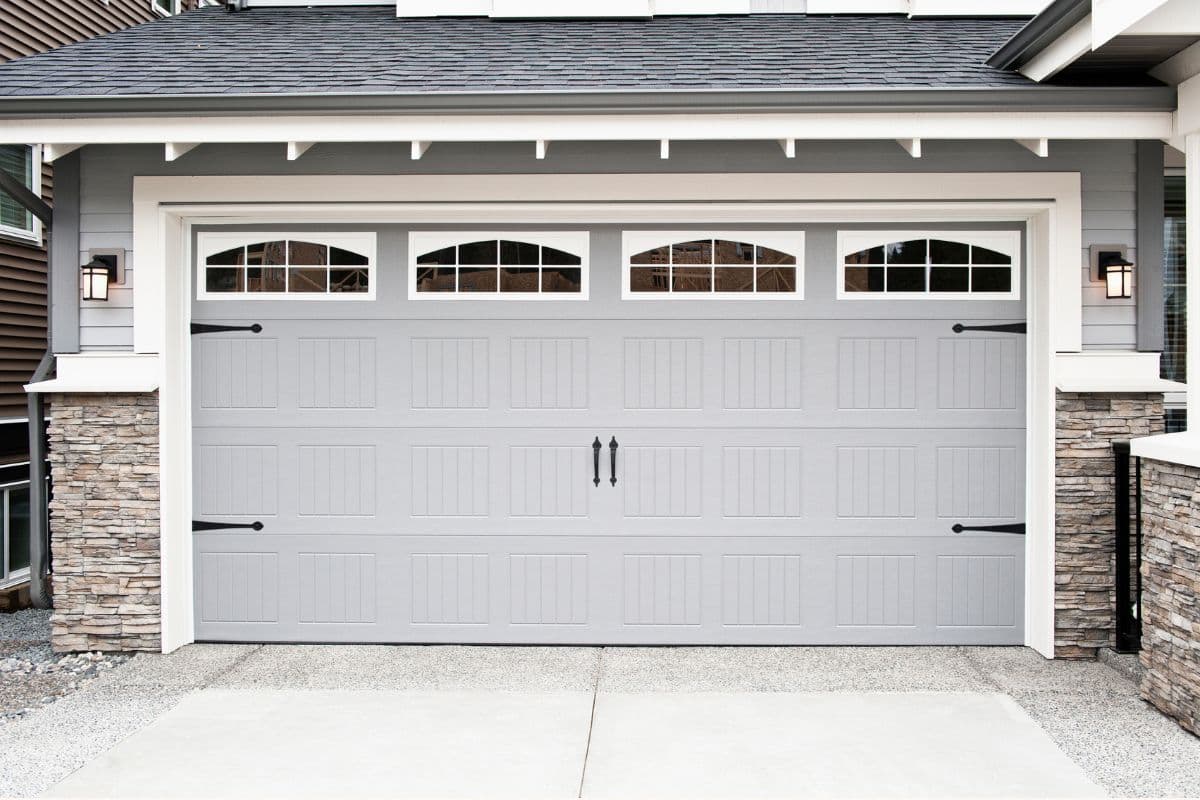
Garage door replacement is the #1 ROI home improvement project in the country. According to the 2025 Cost vs. Value Report by Zonda, it returns 268% of the investment at resale. For every $1,000 you invest, approximately $2,680 is added to your home's value. This guide breaks down every cost component so you know exactly what you're paying for, where you can save money, and whether you actually need a full replacement or just a repair.
Quick estimate: Use our garage door replacement cost calculator to get an instant installed price range based on your door type, size, insulation, opener, and region. The calculator pulls from the same 2026 cost ranges discussed in this guide.
Do You Need Replacement or Repair?
Before spending $1,200 to $4,500 on a new door, make sure you actually need one. Many homeowners search for garage door replacement when a $150 to $700 repair would solve the problem.
| Problem | Fix | Cost | Replace? |
|---|---|---|---|
| Broken spring (door won't open) | Spring replacement | $150 – $350 | No |
| Single dented panel | Panel replacement | $300 – $1,200 | No |
| Noisy operation | Lubrication / hardware tightening | $0 – $50 DIY | No |
| Opener failure | Opener replacement | $200 – $500 | No |
| Weatherstripping worn | Weatherstrip replacement | $50 – $200 | No |
| Off-track door | Track realignment | $150 – $350 | No |
| Multiple dented/damaged panels | Depends on extent | $600 – $2,000 | Maybe |
| Door is 15 to 20 years old | Full replacement | $1,200 – $4,500 | Yes |
| Sagging, warping, rotting wood | Full replacement | $1,200 – $4,500 | Yes |
| No insulation, high energy bills | Replace with insulated door | $1,200 – $4,500 | Yes |
| Outdated look hurting curb appeal | Full replacement | $1,200 – $4,500 | Yes |
The 50% rule: If repair costs exceed 50% of what a new door would cost, replace it. You get a full warranty, better energy efficiency, improved curb appeal, and modern safety features for a marginal cost difference.
If the door is structurally sound but cosmetically worn, painting is a cost-effective alternative to replacement. See our garage door painting guide for materials, prep, and what to expect.
Cost by Door Size
| Door Size | Typical Use | Door Only | Installed |
|---|---|---|---|
| 8×7 ft (single car) | Standard single garage | $400 – $1,400 | $700 – $2,500 |
| 9×7 ft (single car, wide) | SUV/truck accommodation | $500 – $1,600 | $800 – $2,700 |
| 10×7 ft (single car, extra wide) | Large SUV/workshop entry | $600 – $1,800 | $900 – $3,000 |
| 16×7 ft (double car) | Standard two-car garage | $700 – $2,500 | $1,000 – $3,500 |
| 16×8 ft (double car, tall) | Trucks, SUVs with roof racks | $800 – $2,800 | $1,200 – $4,000 |
| 18×7 ft (triple/oversized) | Three-car or extra width | $1,000 – $3,000 | $1,500 – $4,500 |
| Custom sizing | Non-standard openings | $1,500 – $5,000 | $2,500 – $8,000 |
Two single doors vs one double door: For a two-car garage, one 16×7 double door is almost always cheaper than two 8×7 single doors because you need only one frame, one set of tracks, one opener, and one installation. Two singles typically cost 30% to 50% more than one double.
Cost by Material
Material is the single biggest cost factor. It determines price, lifespan, maintenance requirements, insulation value, and appearance.
| Material | Cost (Door Only) | Lifespan | Maintenance | Best For |
|---|---|---|---|---|
| Steel (non-insulated) | $400 – $1,200 | 20–30 yrs | Very low | Budget replacement |
| Steel (insulated) | $700 – $2,000 | 20–30 yrs | Very low | Most homeowners |
| Aluminum | $500 – $1,400 | 20–25 yrs | Very low | Coastal areas (no rust) |
| Vinyl | $600 – $1,500 | 20–25 yrs | Very low | Humid climates |
| Fiberglass | $800 – $2,000 | 15–20 yrs | Low | Coastal, salt air areas |
| Composite/faux wood | $1,000 – $3,000 | 25–30 yrs | Low | Wood look, low maintenance |
| Wood | $1,200 – $4,500 | 15–30 yrs | High (annual) | Traditional, high-end homes |
| Full-view glass/aluminum | $1,500 – $5,000 | 20–25 yrs | Low | Modern/contemporary homes |
The sweet spot for most homeowners: An insulated steel door in the R-12 to R-16 range. It's durable, low-maintenance, energy-efficient, and available in dozens of styles, including faux wood finishes that are nearly indistinguishable from real wood at a fraction of the cost and maintenance. Budget $700 to $2,000 for the door, $1,200 to $3,000 installed.
Cost by Style
| Style | Avg Cost Installed | Description |
|---|---|---|
| Standard raised panel | $800 – $2,000 | Most common residential style, rectangular panels |
| Flush panel | $800 – $2,200 | Clean, flat surface, contemporary look |
| Carriage house | $1,200 – $4,000 | Swing-out barn door appearance, operates like standard overhead |
| Contemporary/modern | $1,500 – $5,000 | Clean lines, minimal hardware, often with windows |
| Full-view glass | $2,000 – $6,000 | Aluminum frame with glass panels, maximum natural light |
| French door style | $2,500 – $7,000 | Decorative panels mimicking French doors |
| Custom/specialty | $3,000 – $10,000 | Fully custom design to match home architecture |
Hidden Costs Most Quotes Don't Include
This is where homeowners get surprised. Your quote for the door and basic installation may not include these items.
| Hidden Cost | Price Range | Notes |
|---|---|---|
| Old door removal and disposal | $50 – $200 | Some installers include this, many don't. Ask. |
| Opener replacement | $200 – $500 | If current opener can't handle new door's weight |
| Track replacement | $150 – $300 | Required if switching door type or size |
| Structural framing repairs | $200 – $1,000 | Rotted header, damaged jambs, out-of-square opening |
| Weatherstripping and bottom seal | $50 – $150 | New door may not include perimeter seals |
| Electrical wiring (new opener) | $150 – $400 | If no existing outlet near the opener location |
| Permits | $50 – $200 | Required in some municipalities |
| Painting/finishing (wood doors) | $200 – $500 | Wood doors arrive unfinished or primed only |
| Smart opener upgrade | $50 – $150 | Adding WiFi connectivity to existing or new opener |
How to avoid surprises: Get a written quote that explicitly states what's included and excluded. Ask specifically about old door removal, hardware, weatherstripping, and any structural work. A $1,500 quote that excludes $400 in extras is really a $1,900 job.
Insulation: Is It Worth the Extra Cost?
Insulated garage doors cost $200 to $600 more than non-insulated versions of the same door. The question is whether that premium pays for itself.
| R-Value | Level | Added Cost | Best For |
|---|---|---|---|
| R-0 | None | Baseline | Detached garages, mild climates, budget projects |
| R-6 to R-9 | Basic | $100 – $200 | Most detached garages, moderate climates |
| R-12 to R-13 | Mid-range | $200 – $400 | Attached garages (recommended minimum) |
| R-16 to R-18 | Premium | $400 – $600 | Heated garages, workshops, rooms above garage |
According to the Department of Energy, an insulated garage door can reduce energy loss through the garage by up to 70% compared to a non-insulated door. In hot or cold climates, the energy savings typically recoup the $200 to $600 insulation premium within two to four years through lower heating and cooling bills.
If you spend time in your garage for a workshop, home gym, or hobbies, insulation also reduces noise transmission and makes the space usable year-round, especially when combined with proper garage heating or cooling.
The ROI That Makes This Worth Every Dollar
Garage door replacement has been the #1 ROI home improvement project for six of the last seven years in the Remodeling Cost vs. Value Report.
| Year | Avg Project Cost | Resale Value Added | ROI |
|---|---|---|---|
| 2023 | $4,302 | $4,418 | 102.7% |
| 2024 | $4,500 | $8,700 | 193.9% |
| 2025 | $4,672 | $12,521 | 268% |
Why is the ROI so high? Three reasons. First, the garage door occupies up to one-third of a home's street-facing facade, making it one of the most visible exterior features. Second, the project cost is relatively low ($1,200 to $4,500 for most homeowners) compared to kitchens and bathrooms. Third, buyers perceive a new garage door as a signal that the entire home has been well-maintained, reducing their anxiety about hidden problems.
How to Save Money on Garage Door Replacement
- •Get three to five quotes. Pricing varies significantly between installers. Multiple quotes help you identify fair market pricing. Don't automatically choose the cheapest since it may not include all necessary components.
- •Choose insulated steel over wood. Modern steel doors with faux wood finishes look remarkably similar to real wood but cost 40% to 60% less, last longer, and require almost no maintenance.
- •Skip unnecessary upgrades. Windows add $300 to $700. Decorative hardware adds $50 to $300. Smart openers add $50 to $150 over basic openers. Be intentional about which upgrades matter for your situation.
- •Buy during the off-season. Late fall and winter are typically the slowest seasons for garage door installers. You may get better pricing or promotional offers during these months.
- •Consider keeping your opener. If your current garage door opener is under 10 years old and working well, it may be compatible with your new door. Keeping a functional opener saves $200 to $500.
- •Don't DIY the installation. Garage door springs are under extreme tension and have caused serious injuries and deaths. Professional installation includes spring balancing, safety testing, opener calibration, and a warranty. The $200 to $500 labor cost is well worth the safety and peace of mind.
For a personalized cost estimate based on your specific door and region, use our garage door cost calculator before requesting installer quotes.
Frequently Asked Questions
How much does it cost to replace a garage door?
A standard garage door replacement costs $1,200 to $4,500 installed, including the door, hardware, and professional installation. A single-car door runs $700 to $2,500, and a double-car door runs $1,000 to $3,500. Premium custom doors can exceed $10,000.
Is replacing a garage door worth it?
Yes. Garage door replacement is the #1 ROI home improvement project in the country, returning 268% of the investment at resale according to the 2025 Cost vs. Value Report. Beyond resale value, a new door improves curb appeal, energy efficiency, security, and daily convenience.
How long does a garage door last?
Most garage doors last 15 to 30 years depending on the material, climate, and maintenance. Steel and composite doors typically last 20 to 30 years. Wood doors last 15 to 30 years with proper annual maintenance. Fiberglass doors last 15 to 20 years.
Should I repair or replace my garage door?
Repair if the door is under 15 years old with isolated damage (single broken spring, one dented panel, worn weatherstripping). Replace if repairs exceed 50% of the replacement cost, the door is 15+ years old, multiple panels are damaged, the door is warping or sagging, or you want improved insulation and curb appeal.
How long does garage door replacement take?
Professional installation typically takes 4 to 6 hours for a standard door, including removal of the old door, installation of the new door, track alignment, spring balancing, opener connection, and safety testing. Custom or complex installations may take a full day.
What is the best material for a garage door?
Insulated steel is the best choice for most homeowners. It's durable, low-maintenance, energy-efficient, and available in numerous styles including convincing faux wood finishes. It offers the best balance of cost, performance, and longevity.
Do I need a permit to replace my garage door?
In most cases, a like-for-like replacement (same size, same location) does not require a permit. If you're changing the size of the opening, adding electrical work, or making structural modifications, a permit may be required. Check with your local building department.
Glossary
R-value
A measure of a garage door's insulation capacity. Higher R-values mean better insulation. R-0 is uninsulated. R-16 to R-18 is premium insulation suitable for attached garages in extreme climates.
Sectional door
The most common residential garage door type. Made of horizontal panels (sections) connected by hinges that bend as the door travels along vertical and horizontal tracks. Nearly all modern residential garage doors are sectional.
Torsion spring
A heavy-duty spring mounted above the door opening that counterbalances the door's weight. Torsion springs are under extreme tension and should only be replaced by professionals. Lifespan: 10,000 to 20,000 cycles (7 to 14 years of typical use).
Extension spring
A spring system that runs along the horizontal tracks on each side of the door. Less expensive than torsion springs but have a shorter lifespan and require safety cables to prevent injury if they break.
Polyurethane insulation
Injected foam insulation that fills the entire cavity of a garage door panel. Provides a higher R-value per inch than polystyrene and adds structural rigidity to the door. Found in mid-range to premium insulated doors.
Polystyrene insulation
Rigid foam board insulation inserted into garage door panels. Less expensive than polyurethane but provides a lower R-value. Found in basic to mid-range insulated doors.
Cost vs. Value Report
An annual study by Zonda published through Remodeling Magazine that compares the average cost of 28 remodeling projects with the value those projects retain at resale across 115 U.S. markets. Garage door replacement has ranked #1 for ROI for six of the last seven years.
Curb appeal
The visual attractiveness of a home as seen from the street. The garage door can occupy up to one-third of a home's street-facing facade, making it one of the most impactful elements of curb appeal and a primary driver of the high ROI for garage door replacement.
Get Homeowner Tips in Your Inbox
Seasonal maintenance reminders, repair guides, and money-saving tips from The Garage Guide — delivered free to your inbox.
By subscribing you agree to receive emails from The Home Guide Network. We respect your privacy. Unsubscribe anytime. Privacy Policy
Get Expert Garage Help
Connect with qualified garage professionals in your area. Free quotes, no obligation.