TL;DR
The best DIY garage floor epoxy kit for most homeowners is the Rust-Oleum RockSolid Polycuramine ($200 to $280 for a 2.5-car kit). It's not technically an epoxy. It's a polycuramine blend that's thicker, harder, and faster-curing than any water-based epoxy kit on the market. It self-levels for a smooth finish, cures to vehicle-ready in 24 hours, and resists hot tire pickup better than standard epoxy.
That said, every DIY kit has limitations. If you haven't read our epoxy garage floor cost guide, start there. It explains why surface preparation determines 80% of whether your floor succeeds or fails, and when hiring a professional is actually cheaper than DIY. If you've decided DIY is right for your garage, these are the kits worth buying.
What to Look For in a DIY Epoxy Kit
Before comparing products, understand the four factors that separate a kit that lasts from one that peels in six months.
| Factor | Why It Matters | What to Look For |
|---|---|---|
| Solids content | Higher solids = thicker coating = longer life | 90%+ solids (polycuramine), 55–60% solids (water-based epoxy) |
| Coating type | Determines durability, cure time, chemical resistance | Polycuramine > 2-part epoxy > 1-part epoxy paint |
| Coverage per kit | Must match your garage size or you'll run short | Check actual coverage (often overstated by 20–30%) |
| Included prep materials | Proper prep is the #1 success factor | Kits with etching solution included save time (diamond grinding is still superior) |
The honest truth about DIY kits: Even the best kit in this list lays down 3 to 5 mils of coating. A professional installation lays down 10 to 20 mils. The DIY version will look great on day one but won't match the longevity of a professional job. If you're comfortable recoating every 3 to 7 years, DIY kits are a reasonable choice. If you want a 15-year floor, hire a pro.
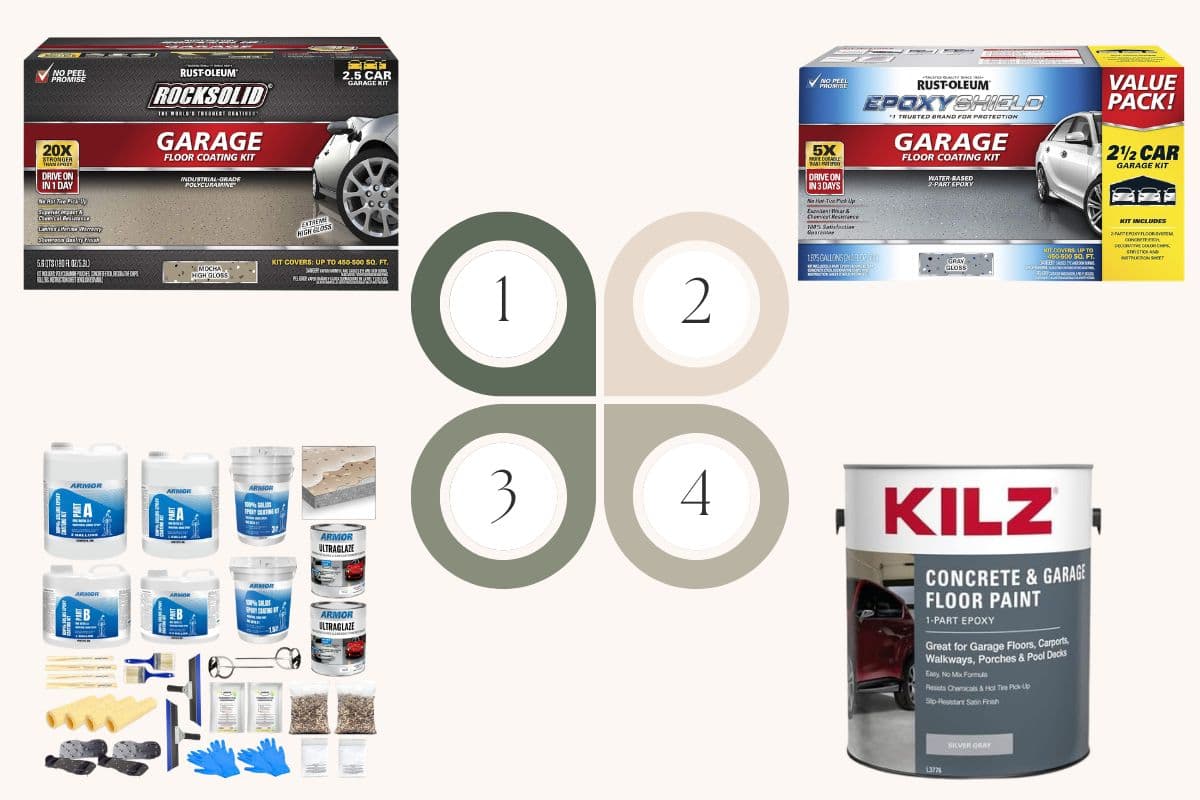
Rust-Oleum RockSolid Polycuramine 2.5-Car Kit
Why it wins: RockSolid isn't a traditional epoxy. It's a proprietary polycuramine blend that combines characteristics of epoxy, polyurethane, and polyurea. The practical result is a coating that's harder, more flexible, and more chemical-resistant than any water-based epoxy in its price range. The 96% solids content means almost no material evaporates during curing, so what you roll on is what stays on the floor.
The burst-pouch mixing system eliminates measuring and mixing errors. You knead the pouch for three minutes, cut the corner, and pour. The self-leveling formula settles into a smooth, glossy finish that hides minor roller marks.
What to know: Real-world coverage is closer to 375 to 425 sq ft per kit, not the 500 sq ft marketed. Buy two single-car kits for a standard 2-car garage to ensure adequate thickness. The coating is slippery when wet. The citric acid etch included in the kit is adequate for clean, bare concrete but won't penetrate previously sealed or painted floors. For those situations, rent a diamond grinder ($150 to $200/day).
Best for: Most homeowners wanting the best DIY result possible on a standard residential garage.
Check Price on AmazonRust-Oleum EpoxyShield 2-Car Kit
Why it's the budget pick: EpoxyShield has been the entry-level garage floor coating for nearly 30 years. At $80 to $130 for a 2-car kit, it's roughly half the price of RockSolid. The 2-part formula is significantly more durable than 1-part epoxy paint. It seals the concrete, resists oil and chemical stains, and gives the garage a clean, finished appearance.
What to know: This is a water-based epoxy with 55% solids, meaning 45% of what you apply evaporates during curing. The resulting coating is thin (2 to 3 mils) and less durable than RockSolid's polycuramine. Expect 2 to 4 years of life with regular vehicle traffic. Hot tire pickup is a real issue with this product.
Best for: Lightly used garages, budget-first projects, or homeowners who want a step up from bare concrete without a major investment.
Check Price on AmazonArmorPoxy ArmorGarage Kit
Why it's the heavy-use pick: ArmorPoxy is the closest thing to a professional-grade system available as a DIY kit. The 100% solids formulation lays down a significantly thicker coating than RockSolid or EpoxyShield. The included clear topcoat adds UV protection and abrasion resistance that the other kits lack. This is the kit for garages that function as workshops, home gyms, or hobby spaces.
What to know: More expensive than the other options and more complex to apply (three separate layers: primer, color coat, topcoat). Total application time is 2 to 3 days. ArmorPoxy strongly recommends diamond grinding over acid etching.
Best for: Workshops, home gyms, heavy-use garages where maximum durability justifies the higher price and longer application process.
Check Price on AmazonRust-Oleum RockSolid Metallic
Why it stands out: If aesthetics are your priority, nothing else in the DIY category comes close to the metallic finish. The metallic pigments create a swirling, three-dimensional effect that mimics high-end commercial installations. Same polycuramine durability as the standard RockSolid but with a dramatically more striking appearance.
What to know: The metallic finish requires more technique than a standard solid-color application. You use a manipulation tool to swirl the metallic pigments while the coating is still wet. You need two kits for a 2-car garage ($500 to $700 total), making this the most expensive DIY option. Color consistency between kits can vary slightly.
Best for: Homeowners who want a showroom-quality appearance and are willing to pay more and practice the application technique.
Check Price on AmazonKILZ 1-Part Epoxy Acrylic
Why it exists: Sometimes the budget is $70 and the goal is just to make the concrete look better than bare gray. KILZ 1-part is essentially a tough garage floor paint with some epoxy resin blended in. It applies like paint (no mixing two parts), covers well in one to two coats, and gives the floor a clean, uniform finish.
What to know: This is paint with epoxy added, not a true 2-part epoxy coating. It will not resist chemical spills, hot tire pickup, or heavy abrasion the way RockSolid or ArmorPoxy will. Expect 1 to 3 years of life with vehicle traffic. No decorative flakes included. No topcoat. This is a stopgap, not a long-term solution.
Best for: Extremely tight budgets, rental properties, or garages where appearance matters more than long-term durability.
Check Price on AmazonQuick Comparison Table
| Kit | Price (2-Car) | Solids | Lifespan | Hot Tire Resistance | Topcoat | Difficulty |
|---|---|---|---|---|---|---|
| RockSolid Polycuramine | $200 – $280 | 96% | 4 – 7 yrs | Good | No (self-sealing) | Easy |
| EpoxyShield 2-Part | $80 – $130 | 55% | 2 – 4 yrs | Poor | No | Easy |
| ArmorPoxy ArmorGarage | $300 – $500 | 100% | 7 – 10 yrs | Excellent | Yes | Moderate |
| RockSolid Metallic | $500 – $700 | 96% | 4 – 7 yrs | Good | No (self-sealing) | Moderate |
| KILZ 1-Part | $70 – $100 | Low | 1 – 3 yrs | Poor | No | Very easy |
The honest truth about DIY garage floor epoxy: Even the best DIY kit will not match the thickness, adhesion, or longevity of a professional installation with industrial-grade materials and diamond-ground prep. A professional job costs $3 to $7 per square foot and lasts 10 to 20 years. A DIY kit costs $0.50 to $2 per square foot and lasts 2 to 7 years depending on the product. DIY epoxy is a great option if you want a significant upgrade from bare concrete at a fraction of the cost. Just go in with realistic expectations and follow the prep instructions exactly.
Frequently Asked Questions
What is the best DIY epoxy for a garage floor?
For most homeowners, Rust-Oleum RockSolid Polycuramine offers the best balance of durability, ease of application, and value. Its 96% solids formula creates a thicker, harder coating than traditional epoxy kits, and the one-day cure time means less garage downtime.
How long does DIY garage floor epoxy last?
It depends on the product and prep quality. Budget epoxy paint like KILZ lasts 1 to 3 years. Mid-range 2-part epoxies like EpoxyShield last 2 to 4 years. High-performance polycuramine like RockSolid lasts 4 to 7 years. Professional-grade kits like ArmorPoxy can last 7 to 10 years with proper application.
Is RockSolid better than EpoxyShield?
Yes, in almost every measurable way. RockSolid uses polycuramine (96% solids) vs EpoxyShield's traditional epoxy (55% solids), resulting in a harder, thicker coating that resists hot tire pickup and chemicals better. The main advantage of EpoxyShield is its lower price point.
Do I need a topcoat over garage floor epoxy?
It depends on the product. RockSolid Polycuramine is self-sealing and does not require a topcoat. Traditional 2-part epoxies like EpoxyShield benefit from a clear topcoat for UV protection and added durability, though one is not included. ArmorPoxy kits include a topcoat as part of the system.
Can I apply epoxy over old paint or coating?
Generally no. Epoxy needs to bond directly to clean, porous concrete. Old paint, sealers, or coatings must be removed first, usually by diamond grinding. Applying over existing coatings is the most common cause of epoxy failure and peeling.
How many kits do I need for a 2-car garage?
A standard 2-car garage is roughly 400 to 500 square feet. RockSolid Polycuramine covers up to 500 sq ft per kit (one kit is sufficient). EpoxyShield covers about 250 sq ft (you need two kits). ArmorPoxy covers 450 to 500 sq ft per kit. Always measure your actual floor area before ordering.
Related Guides
Epoxy Garage Floor Cost
Full breakdown of DIY vs professional epoxy costs in 2026
Cost GuideGarage Floor Coating Cost
All coating types compared by cost and durability
ProblemGarage Floor Oil Stains
Remove oil before coating or the floor will fail
ProblemCracked Garage Floor
Assess and repair cracks before applying any coating
GuideComplete Garage Guide
All 9 garage systems explained for homeowners