The Garage Guide
Updated Apr 2026 · 12 min read
Garage Insulation Cost 2026: Door, Walls, Ceiling, and Whole Garage Prices
Full breakdown by insulation type, surface, and garage size. DIY vs professional costs for every approach.
TL;DR
Garage door insulation kits cost $50 to $200 DIY or $150 to $400 installed. A new insulated garage door costs $1,100 to $4,200 installed. Insulating the full garage (walls and ceiling) costs $800 to $5,100 for a standard 2-car garage professionally installed, or $300 to $1,500 in materials for a complete DIY job. The biggest cost variable is insulation type: fiberglass batts are cheapest at $0.50 to $1.50 per square foot installed, spray foam is most expensive at $1.50 to $5.00 per square foot. For most homeowners, the highest return on investment comes from insulating the garage door first, then the shared wall between the garage and living space, then the ceiling.
Garage insulation pricing is confusing because most quotes mix together three different projects: the garage door, the walls, and the ceiling. Each surface has different insulation types, different R-value targets, and different labor requirements. A quote for "insulating the garage" without specifying which surfaces and which insulation type is meaningless.
This guide breaks down costs by individual surface and insulation type so you can price exactly the scope of work you need. Whether you are insulating just the garage door for $50 or doing a full spray foam job for $8,000+, the cost data below covers it.
For the installation process itself, see our how to insulate a garage guide.
The R-Value Rule: Why the Number You Choose Drives the Cost
R-value measures thermal resistance. Higher R-value means better insulation. Every cost in this guide is tied to an R-value target because R-value determines insulation thickness, material type, and labor complexity.
For garage walls with 2x4 studs (3.5 inches deep), the maximum fiberglass batt R-value is R-15. With 2x6 studs (5.5 inches deep), you can reach R-21. Spray foam can achieve higher R-value per inch, but at significantly higher cost per square foot.
For garage ceilings, the target depends on climate zone and whether there is living space above. Unconditioned attic above the garage: R-38 to R-49. Living space above the garage: R-30 minimum, R-38 preferred.
For the garage door, R-6 to R-13 covers most residential applications. Higher R-values on the door have diminishing returns because the door has so many air gaps around the edges that the effective R-value is lower than the panel rating.
The DOE's insulation guide provides R-value recommendations by climate zone if you want to verify what your area requires.
Garage Door Insulation Cost
The garage door is the largest single opening in the building envelope and typically the least insulated surface. There are two approaches: retrofit an existing door with an insulation kit, or replace the door with a factory-insulated model.
Important
Insulating the garage door only delivers meaningful energy savings if the rest of the garage envelope is also addressed. An insulated door on an uninsulated garage is like putting a storm window in a house with no roof. Start with the door if budget is limited, but understand that the full benefit comes from insulating all surfaces.
Garage Door Insulation Kit Cost (Retrofit)
Retrofit kits use pre-cut foam panels that press-fit or adhesive-mount into each door panel. Installation is a 1 to 3 hour DIY project requiring no special tools.
| Kit Type | R-Value | 1-Car Door Cost | 2-Car Door Cost | DIY or Pro |
|---|---|---|---|---|
| Foam board panels (EPS) | R-4 to R-6 | $50 to $80 | $90 to $150 | DIY |
| Reflective foil panels | R-6 to R-8 | $60 to $100 | $100 to $180 | DIY |
| Polyurethane foam panels | R-8 to R-13 | $80 to $150 | $150 to $300 | DIY |
| Professional kit installation | Varies | Add $100 to $200 | Add $150 to $300 | Pro |
New Insulated Garage Door Cost
Factory-insulated doors deliver better R-value, better air sealing, and better durability than retrofit kits. If your existing door is over 15 years old or already damaged, replacement with an insulated model is usually the better investment. See our garage door replacement cost guide for complete door pricing.
| Door Configuration | Double-Layer (R-6 to R-9) | Triple-Layer (R-12 to R-18) |
|---|---|---|
| Single door (8x7 or 9x7) installed | $750 to $1,200 | $1,100 to $1,500 |
| Double door (16x7) installed | $1,100 to $2,200 | $1,800 to $4,200 |
Garage Insulation Cost by Surface
Garage Wall Insulation Cost
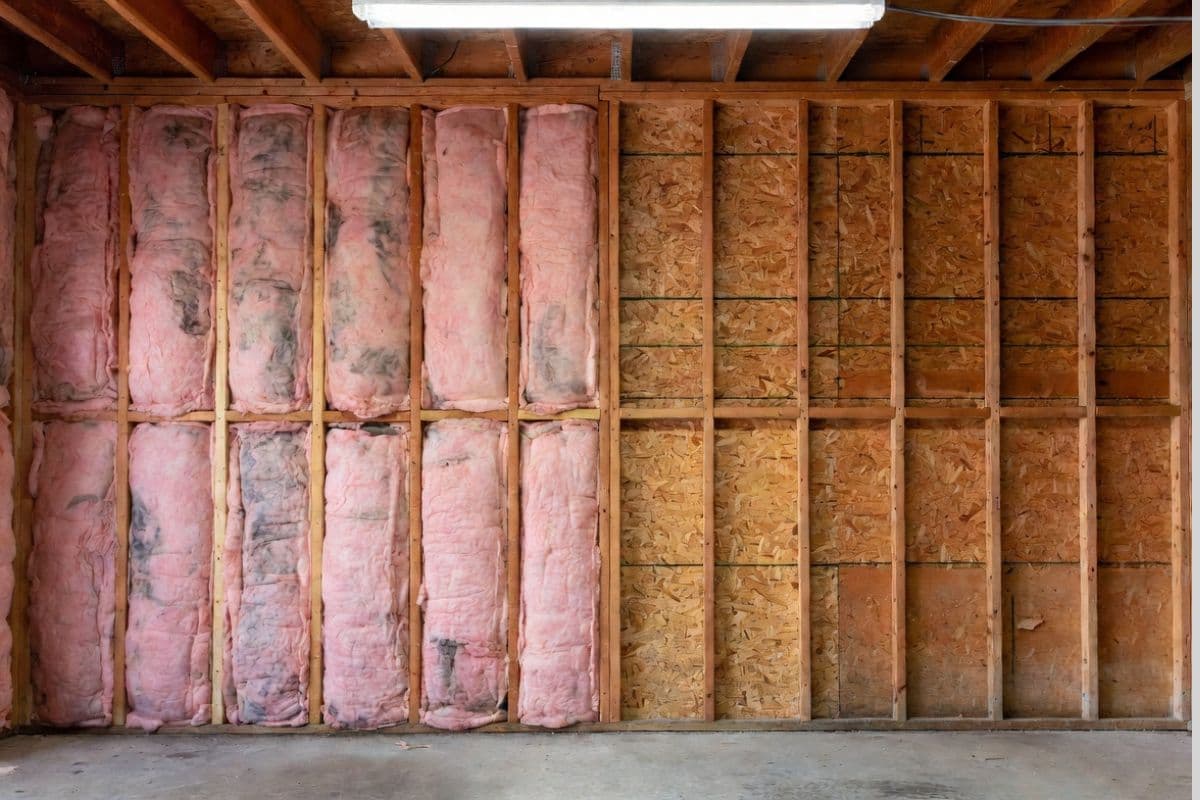
Wall insulation cost depends on stud depth, insulation type, and whether the walls are open stud (easy access) or already covered with drywall (requires removal or blown-in fill). The figures below assume open stud walls, which is the most common scenario in unfinished garages.
| Insulation Type | DIY Cost per Sq Ft | Installed Cost per Sq Ft | R-Value per Inch |
|---|---|---|---|
| Fiberglass batts | $0.30 to $0.80 | $0.50 to $1.50 | R-3.2 to R-3.8 |
| Mineral wool batts | $0.50 to $1.20 | $0.80 to $1.80 | R-3.3 to R-4.2 |
| Rigid foam board (XPS/EPS) | $0.40 to $1.00 | $0.75 to $1.60 | R-3.8 to R-5.0 |
| Open-cell spray foam | N/A (pro only) | $1.00 to $2.00 | R-3.5 to R-3.7 |
| Closed-cell spray foam | N/A (pro only) | $1.50 to $5.00 | R-6.0 to R-7.0 |
A standard 2-car garage has roughly 400 to 600 square feet of wall area (excluding the garage door opening). At fiberglass batt pricing, that is $200 to $900 installed. At closed-cell spray foam pricing, that is $600 to $3,000 installed.
If the garage shares a wall with the living space, insulate that wall first. It is the highest-return surface because it directly reduces heat transfer between the conditioned house and the unconditioned garage.
Garage Ceiling Insulation Cost
Ceiling insulation cost depends on whether the ceiling has open joists (easy access) or is already drywalled. For garages with living space above, ceiling insulation is critical for both energy efficiency and noise reduction.
| Insulation Type | DIY Cost per Sq Ft | Installed Cost per Sq Ft |
|---|---|---|
| Fiberglass batts (R-30 to R-38) | $0.50 to $1.20 | $1.00 to $2.00 |
| Blown-in fiberglass or cellulose | $0.40 to $0.80 | $0.80 to $1.50 |
| Open-cell spray foam | N/A (pro only) | $1.50 to $3.00 |
| Closed-cell spray foam | N/A (pro only) | $2.00 to $5.00 |
A standard 2-car garage ceiling is 400 to 576 square feet. At fiberglass batt pricing, that is $400 to $1,150 installed. Ceiling work costs more per square foot than walls because of overhead labor and the need for scaffolding or lifts in some garages.
Total Garage Insulation Cost by Garage Size and Type
These totals combine wall and ceiling insulation only. Add garage door insulation costs from the tables above for a complete project total.
| Garage Configuration | Fiberglass Pro | Spray Foam Pro | DIY Fiberglass |
|---|---|---|---|
| 1-car garage (12x20) | $800 to $2,000 | $2,000 to $5,500 | $300 to $800 |
| 2-car garage (20x24) | $1,500 to $3,800 | $3,500 to $8,500 | $400 to $1,200 |
| 3-car garage (30x24) | $2,500 to $5,100 | $5,000 to $12,000 | $700 to $1,500 |
| Detached garage with all 4 walls | $2,000 to $5,000 | $4,500 to $10,000 | $600 to $1,500 |
For electrical needs during garage projects, see our detached garage electrical guide.
What Drives the Price Up or Down
Insulation type is the biggest cost driver. Closed-cell spray foam costs 3 to 5 times more than fiberglass batts per square foot. The higher cost buys a higher R-value per inch, a built-in vapor barrier, and superior air sealing, but the cost difference is significant on a whole-garage project.
Wall condition matters. Open stud walls are the easiest and cheapest to insulate. If the garage already has drywall, it must be removed to install batts or spray foam (adding $1 to $3 per square foot in demolition and replacement) or you can opt for blown-in insulation through drilled holes at $1.50 to $3 per square foot.
Ceiling height affects labor cost. Standard 8-foot ceilings are straightforward. High ceilings (10 to 14 feet in some garages) require scaffolding and add 15% to 25% to the labor cost.
Code requirements vary by location. Some jurisdictions require specific R-values, vapor barriers, or fire-rated drywall over insulation in garages that share a wall with the living space. Drywall over insulation adds $1.50 to $3 per square foot to the total project cost.
Climate zone determines the R-value target, which determines the insulation thickness and cost. A garage in Phoenix targeting R-13 walls costs less than a garage in Minneapolis targeting R-21 walls simply because of material thickness.
Access is often overlooked. If the garage is cluttered, full of stored items, or has vehicles that need to be moved, the contractor will charge for the setup time. Clear the garage before the crew arrives to avoid a surprise line item.
DIY vs Professional Cost Comparison
Fiberglass batt installation is one of the most accessible DIY insulation projects. Spray foam is firmly in the professional-only category. Here is the cost breakdown side by side.
| Project | DIY Cost | Professional Cost | Time Required |
|---|---|---|---|
| Garage door retrofit kit (2-car) | $90 to $300 | $250 to $600 | 1 to 3 hours |
| Walls fiberglass batts (2-car) | $150 to $500 | $500 to $1,800 | 4 to 8 hours |
| Ceiling fiberglass batts (2-car) | $200 to $600 | $600 to $2,000 | 4 to 8 hours |
| Full walls + ceiling fiberglass (2-car) | $400 to $1,200 | $1,500 to $3,800 | 1 to 2 days |
| Full walls + ceiling spray foam (2-car) | N/A | $3,500 to $8,500 | 1 day |
The DIY savings on a full 2-car garage fiberglass project are $1,000 to $3,000 versus professional installation. The tradeoff is a weekend of labor working overhead with fiberglass (wear long sleeves, a respirator, and safety glasses). If any part of the opener system is affected during the project, see our garage door opener troubleshooting guide.
Is Garage Insulation Worth the Cost?
The answer depends entirely on how you use the garage and where you live.
Attached garage with shared wall: Almost always worth it. The shared wall is a direct thermal bridge between your conditioned living space and the unconditioned garage. Insulating the garage reduces energy loss through that wall, which lowers heating and cooling costs. In cold climates, the payback on fiberglass insulation in the shared wall is typically 2 to 4 years.
Garage used as workspace: Clearly worth it. If you spend time in the garage as a workshop, gym, or hobby space, insulation makes it usable year-round. Combined with a properly maintained heating or cooling system, insulation transforms the space from seasonal to permanent.
Detached garage for car storage only: The payback is longest here. If you do not heat or cool the garage and only use it for parking, the primary benefit is protecting stored items from extreme temperature swings and reducing moisture buildup. In mild climates, this may not justify the cost. In cold climates where pipes in the garage could freeze, insulation is a practical investment.
EV charging: Lithium batteries charge most efficiently between 50°F and 86°F. An insulated garage keeps the battery in that range more often, which can improve charging speed and battery longevity. See our EV charger installation guide for charging setup details.
Frequently Asked Questions
How much does it cost to insulate a garage door?
A DIY retrofit insulation kit for a 1-car garage door costs $50 to $150 and takes 1 to 3 hours to install. A 2-car door kit costs $90 to $300. Professional installation of a retrofit kit adds $150 to $300 in labor. Replacing an existing door with a factory-insulated model costs $750 to $1,500 installed for a single door or $1,500 to $4,200 installed for a double door.
How much does it cost to insulate a 2-car garage?
Insulating the walls and ceiling of a standard 2-car garage costs $1,500 to $3,800 professionally installed with fiberglass batts, or $3,500 to $8,500 with spray foam. A DIY fiberglass batt project for the same garage costs $400 to $1,200 in materials. These figures cover walls and ceiling only. Add $90 to $300 for a garage door retrofit kit or $1,500 to $4,200 for a replacement insulated door.
What is the cheapest way to insulate a garage?
The cheapest approach is DIY fiberglass batt insulation in open stud walls and ceiling, combined with a foam panel retrofit kit for the garage door. Materials for a complete 2-car garage DIY project run $400 to $1,500 depending on garage size and target R-value. The labor savings from DIY versus professional installation are $1,000 to $3,000 on a typical 2-car garage project.
Is it worth insulating a detached garage?
It depends on how you use the garage. If it is used only for car storage in a mild climate, the payback period is long. If you use the garage as a workshop, gym, or hobby space, or if you are in a cold climate, insulation delivers clear value. For a detached garage, prioritize the ceiling first, then exterior walls, then the door.
Does garage insulation require a permit?
Insulation alone without drywall work typically does not require a permit in most jurisdictions. Adding drywall over insulation in a garage typically does require a permit because it affects the fire separation between the garage and living space. Always check with your local building department before starting.
What R-value do I need for my garage?
For garage walls, R-13 to R-21 covers most residential situations depending on stud depth and climate. For the ceiling, R-38 to R-49 is appropriate for most climates. For the garage door, R-6 to R-13 covers most residential applications. In very cold climates, maximize R-value in every surface.
How long does garage insulation last?
Fiberglass batts last 80 to 100 years under normal conditions without moisture damage. Rigid foam boards last 25 to 50 years. Spray foam lasts 80 to 100 years if properly installed. The primary threat to garage insulation lifespan is moisture. Proper vapor barriers and air sealing during installation protect insulation from moisture damage.
Can I insulate my garage myself?
Yes for fiberglass batts and garage door retrofit kits. No for spray foam. Fiberglass batt installation in open stud walls and ceilings is a straightforward project with a low skill floor. Garage door retrofit kits install in 1 to 3 hours with no special tools. Spray foam requires specialized equipment and correct chemical mixing ratios that make DIY impractical for most homeowners.
Related Guides
How to Insulate a Garage
Step-by-step installation for every insulation type.
GuideDetached Garage Electrical
Wiring, panels, and code requirements for detached garages.
ProblemGarage Door Opener Not Working
Diagnose and fix opener problems step by step.
GuideEV Charger Installation Cost
Costs, levels, and tax credits for home EV charging.
GuideGarage Maintenance Checklist
Every season, every system, every task.
Glossary
R-value
A measure of thermal resistance. Higher R-value means better insulation. R-value is additive: two layers of R-13 insulation yield R-26. R-value is measured per inch of thickness, so different insulation types achieve different R-values in the same wall depth.
Fiberglass batt
Pre-cut blankets of spun glass fibers designed to fit between standard wall studs (16 or 24 inches on center). The most common and least expensive residential insulation type. Available in faced (with kraft paper vapor barrier) and unfaced versions.
Mineral wool (Rockwool)
A batt insulation made from basalt rock and recycite. Higher density and higher R-value per inch than fiberglass. Naturally fire-resistant, water-repellent, and provides better soundproofing than fiberglass. Costs 25% to 50% more than fiberglass batts.
Closed-cell spray foam
A rigid expanding foam insulation applied as a liquid spray that hardens into a dense solid. Achieves R-6 to R-7 per inch, the highest of any common residential insulation. Acts as its own vapor barrier. The most expensive option but delivers the best thermal performance per inch.
Open-cell spray foam
A softer, less dense spray foam that expands to fill cavities completely. Achieves R-3.5 to R-3.7 per inch. Lower cost than closed-cell but does not act as a vapor barrier. Good for air sealing but requires a separate vapor barrier in cold climates.
Rigid foam board (XPS/EPS/Polyiso)
Solid panels of foam insulation that can be cut and fitted to walls, ceilings, and garage door panels. XPS (extruded polystyrene) is blue or pink, R-5 per inch. EPS (expanded polystyrene) is white, R-3.8 per inch. Polyiso (polyisocyanurate) is foil-faced, R-6 per inch but performance decreases in cold temperatures.
Vapor barrier
A material (polyethylene sheeting, kraft paper facing, or the closed-cell foam itself) that prevents moisture from passing through the wall assembly. In cold climates, the vapor barrier goes on the warm side (interior) of the insulation. Incorrect vapor barrier placement causes moisture to condense inside the wall, damaging insulation and framing.
Thermal bridge
A pathway through the building envelope that conducts heat more readily than the surrounding insulated areas. In garages, the most common thermal bridges are the wall studs themselves, the concrete slab edge, and the garage door frame. Continuous insulation on the exterior side of the studs eliminates stud thermal bridging.
Air sealing
The process of closing gaps, cracks, and penetrations in the building envelope to prevent uncontrolled air movement. Air sealing is at least as important as insulation R-value for energy performance. Common air sealing targets in garages include the bottom plate of walls, electrical penetrations, pipe penetrations, and the joint between the wall and ceiling.