The Garage Guide
Updated Mar 2026 · 22 min read
The Complete Garage Guide 2026: Every System, Every Decision, Every Cost
The reference guide for homeowners who want to understand what they own, plan improvements confidently, and avoid the safety and code mistakes most homeowners never know they are making.
Quick answer: Your garage is one of the most complex and underappreciated systems in a home. It contains structural elements, a mechanical door system, a finished or unfinished floor, heating and cooling equipment, lighting, electrical circuits, storage systems, and in modern homes an EV charging station. For attached garages it also contains code-required fire separation from the living space that most homeowners have never inspected and many homes get wrong. This guide covers every major garage system — what it is, how it works, what it costs to improve or repair, and what the most common mistakes are. Whether you are buying a home with a garage, planning improvements, or simply trying to understand what you own, this is the reference you need.
In This Guide
Attached vs. Detached: Why the Distinction Matters
Before covering any specific garage system, the attached vs. detached distinction needs to be established because it changes the rules for nearly everything else in this guide.
An attached garage shares at least one wall with the living space of the home. It is the most common configuration in American residential construction. The shared wall creates a direct fire and carbon monoxide pathway between the garage and the home, which is why the International Residential Code (IRC) imposes specific fire separation requirements that do not apply to detached garages. Attached garages also affect the home's thermal performance — an uninsulated attached garage can account for 10 to 15 percent of a home's heating and cooling loss.
A detached garage is a separate structure with no shared walls with the home. It has fewer code requirements in most jurisdictions and does not create the same fire or CO pathway risk. However, it has its own considerations for electrical supply (it typically requires a separate subpanel fed from the main house panel), weatherproofing, and foundation requirements.
Throughout this guide, situations where the attached vs. detached distinction changes the guidance are clearly noted.
Structure, Walls, and Fire Separation
The Garage Structure
A residential garage is typically a wood-framed structure with a concrete slab foundation. The walls are 2x4 or 2x6 framing, the roof is typically truss-framed, and the entire assembly sits on a poured concrete slab that slopes slightly toward the garage door opening for drainage.
The concrete slab in most garages is 4 inches thick — the minimum for passenger vehicle loads. Heavy trucks, RVs, or lifts may require a thicker slab or additional reinforcement. Cracking in a garage floor is common and does not always indicate a structural problem. See the cracked garage floor guide for how to diagnose which cracks are cosmetic and which require repair.
Fire Separation Requirements for Attached Garages
This is the section most homeowners need to read and almost none of them ever do.
The International Residential Code (IRC) requires specific fire separation between an attached garage and the living space of the home. These requirements exist because garages concentrate fire hazards — stored gasoline, motor oil, paint, and other flammable materials, plus vehicles that carry fuel. A garage fire that reaches the living space without any separation can kill occupants before they can escape.
IRC Fire Separation Requirements for Attached Garages
- ■Shared walls: The wall between an attached garage and the living space must have at least 1/2-inch gypsum board (drywall) applied to the garage side. Standard drywall — not the unfinished framing that many older garages show.
- ■Ceiling above living space: If there is living space above the garage (a bedroom, bonus room, or any habitable space), the garage ceiling must be covered with 5/8-inch Type X gypsum board. Type X is a fire-rated drywall formulation that provides greater fire resistance than standard 1/2-inch drywall.
- ■The door between the garage and house: The door must be either solid wood at least 1-3/8 inches thick, solid or honeycomb-core steel at least 1-3/8 inches thick, or rated for at least 20 minutes of fire resistance. It must be self-closing and self-latching. A hollow-core interior door does not meet this requirement. Glass panels in this door are not fire-rated and constitute a breach of the fire separation.
- ■Penetrations: Any pipes, wires, or ducts that penetrate the fire separation wall must be properly fire-blocked. An electrical outlet box with gaps around it creates a pathway for fire and smoke to enter the living space.
What this means for homeowners: If your attached garage has unfinished walls on the garage side, a hollow-core door, or a door that does not self-close and self-latch, your garage does not meet current fire separation requirements. These are not cosmetic issues — they are life safety issues. A licensed contractor or home inspector can assess your specific situation.
What a Home Inspector Looks for in the Garage
- ☐Fire separation wall condition (drywall present and intact on garage side)
- ☐Door type and self-closing mechanism
- ☐GFCI protection on all garage outlets
- ☐CO detector in the adjacent living space
- ☐Garage door operation and safety sensor function
- ☐Floor condition and drainage
- ☐Evidence of water intrusion or staining
- ☐Subpanel condition if present
- ☐Any signs of chemical storage or spill contamination on the floor
Buyers evaluating a property with an attached garage should specifically ask the inspector about fire separation compliance. Non-compliant fire separation is a common finding and one that sellers sometimes omit from disclosure.
The Garage Door System
The garage door is the largest moving mechanical system in most homes and the one that requires the most regular maintenance to operate safely.
Garage Door Types
Sectional doors are the standard in American residential construction — horizontal panels hinged together that roll up along tracks mounted to the ceiling. They are reliable, available in every material and price point, and work with any overhead space configuration. Most residential garage doors installed in the last 30 years are sectional.
One-piece tilt-up doors are an older design where a single panel swings outward and up as a unit. They require more clearance in front of the garage and are less common in new construction.
Roll-up doors are common in commercial applications and increasingly available for residential use. The door rolls into a compact drum above the opening rather than along ceiling tracks, which maximizes ceiling clearance.
Garage Door Materials
| Material | Typical Cost (2-car) | Insulation | Lifespan | Best For |
|---|---|---|---|---|
| Steel ★ | $400 to $1,200 | Yes | 20 to 30 years | Most homes, best value |
| Aluminum | $600 to $2,000 | Limited | 15 to 25 years | Modern aesthetics, coastal |
| Wood | $800 to $5,000 | No (minimal) | 15 to 25 years | Traditional, custom looks |
| Wood composite | $800 to $3,500 | Yes | 20 to 30 years | Wood look, less maintenance |
| Fiberglass | $700 to $2,500 | Yes | 20 to 30 years | Coastal, high humidity |
An insulated garage door (typically steel with polystyrene or polyurethane foam fill) is worth the modest premium over an uninsulated door for any attached garage. A well-insulated garage door can have an R-value of R-12 to R-18, compared to R-2 or less for an uninsulated door.
See the garage door replacement cost guide for the complete cost breakdown including installation.
Springs and Safety
Torsion Spring Safety Warning
The torsion springs above the garage door are under extreme tension and are the most dangerous component of the garage door system. A broken spring is identifiable by a loud bang, inability to open the door, and a visible gap or misalignment in the spring assembly.
Do not attempt to replace or adjust garage door springs yourself. The stored energy in a wound torsion spring can cause serious injury if released improperly.
Professional spring replacement costs $150 to $350 and takes approximately one hour.
Garage Door Openers
A garage door opener should be replaced if it is over 20 years old and lacks modern safety features, or if it was manufactured before 1993 when auto-reverse safety requirements became mandatory. Modern openers include auto-reverse sensors, rolling code technology, battery backup, and smartphone connectivity.
See the best garage door openers review for specific model recommendations across budget tiers.
Garage Flooring
The concrete slab is the starting point for every garage flooring decision. Understanding what is under any coating or covering is essential before making improvements.
Bare Concrete
Untreated concrete is porous, absorbs oil and chemicals, produces fine dust as it degrades, and stains easily. It is also adequate for most garage uses in its bare state and requires no maintenance beyond occasional cleaning. The decision to coat or cover the floor is an improvement choice, not a necessity.
Epoxy Coatings
Epoxy is the most popular DIY garage floor coating. It bonds chemically to concrete, creates a hard, semi-gloss surface that resists oil and chemical staining, and is available in a wide range of colors and chip patterns. A properly applied epoxy coating lasts 3 to 5 years in a residential garage before it begins to peel or chip at high-wear areas.
The most common failure mode is moisture vapor transmission — water vapor rising through the concrete from below causes the epoxy to delaminate from the slab. A simple moisture test before application (taping a square of plastic sheeting to the floor for 24 hours and checking for condensation) can identify whether vapor transmission is a problem on your slab.
See the best garage floor epoxy kits review for DIY options and the garage floor coating cost guide for professional application pricing.
Polyurea and Polyaspartic Coatings
Professional-grade polyurea and polyaspartic coatings outperform epoxy in every performance dimension — harder surface, better chemical resistance, UV stability (epoxy yellows with sunlight exposure), and faster cure time. They are also significantly more expensive. A professionally applied polyurea coating on a two-car garage floor typically costs $3,000 to $7,000 installed, compared to $500 to $1,500 for a professional epoxy application.
Interlocking Tile Systems
Interlocking polypropylene or rubber floor tiles are a no-glue alternative to coatings. They snap together over the existing concrete, can be removed and reinstalled if needed, and require no surface preparation beyond cleaning. Cost runs $2 to $6 per square foot for materials only.
Heating and Cooling
A garage in an extreme climate is either too hot to work in during summer or too cold to use during winter without conditioning. The right heating and cooling strategy depends on whether the garage is attached or detached, how it is insulated, and what the primary use is.
Insulation First
Heating or cooling an uninsulated garage is wasteful and ineffective. Before investing in any HVAC equipment, address the insulation. A properly insulated garage requires significantly less heating and cooling capacity to maintain a comfortable temperature.
Recommended R-values for garage insulation:
- Garage walls (shared with living space): R-13 to R-21 depending on climate zone
- Garage walls (exterior): R-13 minimum
- Garage ceiling: R-38 to R-60 in cold climates
- Garage door: R-12 to R-18 (insulated steel door)
See the how to insulate your garage guide for the complete installation guide by component.
Heating Options
| Heater Type | Best For | BTU Range | Cost Range | Notes |
|---|---|---|---|---|
| Forced air ★ | Large garages, frequent use | 30,000 to 75,000 | $500 to $2,000 installed | Heats quickly, requires gas line |
| Infrared tube | Workshops, spot heating | 20,000 to 50,000 | $600 to $1,500 installed | Heats objects not air, efficient |
| Electric wall | Small garages, occasional use | 4,000 to 17,000 | $200 to $800 installed | No gas needed, higher operating cost |
| Mini-split ★ | Year-round, heating and cooling | 9,000 to 24,000 | $1,500 to $4,000 installed | Most comfortable, highest upfront cost |
| Portable electric | Temporary, small spaces | 5,000 to 10,000 | $50 to $300 | No installation, least efficient |
BTU Sizing Rule of Thumb
For a well-insulated garage: approximately 10 BTU per cubic foot of garage volume.
A 2-car garage (24 x 24 feet with 8-foot ceilings) has approximately 4,600 cubic feet and needs approximately 46,000 BTU of heating capacity in a cold climate.
See the garage heater guide for the complete heating comparison and the best garage heaters review for specific product recommendations.
Cooling Options
Most garages in warm climates are addressed through ventilation rather than active cooling. A well-ventilated garage with insulation stays 10 to 15 degrees cooler than an unventilated one in summer without any mechanical cooling. Adding a whole-garage exhaust fan, ceiling fan, or wall fan is the most cost-effective first step.
For garages used as workshops, gyms, or conditioned hobby spaces, a mini-split system provides both heating and cooling from a single installation. See the garage too hot in summer guide for the complete ventilation and cooling strategy.
Lighting
A poorly lit garage is both less functional and less safe than a well-lit one. Most stock-built garages have a single light fixture switched from the garage door opener — typically one or two 60-watt equivalent bulbs illuminating a 2-car space that requires significantly more light to work in comfortably.
Lighting Levels
The Illuminating Engineering Society (IES) recommends a minimum of 50 footcandles for general garage use and 100 footcandles for detailed workshop tasks. Most stock garage lighting delivers 10 to 20 footcandles. Upgrading garage lighting from stock is one of the highest-return improvements for usability.
Practical planning: A standard 2-car garage (24 x 24 feet = 576 square feet) needs approximately 28,800 lumens for 50 footcandles of coverage. Four to six high-output LED shop lights (each producing 5,000 to 6,000 lumens) is the typical solution.
LED Shop Lights
LED shop lights designed for garage and workshop use are the recommended solution for most homeowners. They are linkable (daisy-chaining multiple fixtures on a single circuit), energy-efficient, bright, and available at home improvement stores for $30 to $80 per fixture. They are typically plug-in or hardwire, making DIY installation straightforward.
See the best garage lighting review for specific product recommendations by garage size.
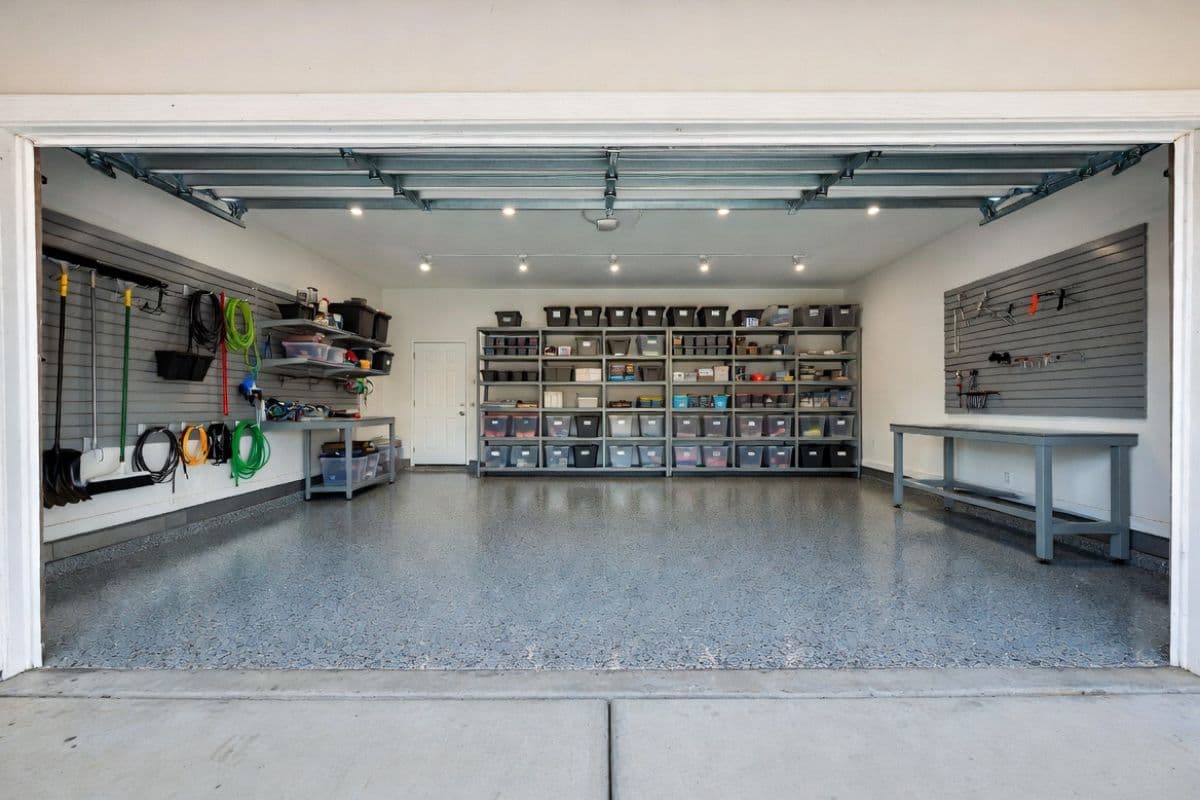
Storage and Organization
An organized garage is one of the most valuable improvements a homeowner can make — not in terms of resale value, but in terms of daily usability. The most effective garage organization systems use wall space, ceiling space, and cabinets in combination rather than relying on floor storage.
Wall Storage Systems
Wall-mounted track systems (slatwall panels, wall channels, or pegboard) allow flexible tool and equipment storage at any height. The key advantage is adjustability — hooks, shelves, and baskets can be repositioned as needs change. Professional slatwall systems cost $300 to $800 for a standard 2-car garage wall. Pegboard is less expensive ($50 to $150) but less durable and less versatile.
Overhead Storage
Ceiling-mounted overhead storage racks are the most underused square footage in most garages. A standard 2-car garage has 576 square feet of floor space and an equivalent or greater amount of ceiling area, most of which goes unused. Overhead racks designed for seasonal storage can free significant floor space. Ceiling-mounted racks range from $100 to $400 for DIY systems up to $800 to $1,500 for professional-installed systems.
Cabinets
Garage-specific cabinets provide closed storage for tools, chemicals, and items that benefit from being out of sight or protected from dust. Steel cabinets are more durable than wood in the garage environment where humidity fluctuates significantly. See the best garage storage systems review and the best garage cabinets review for specific recommendations.
See the complete garage organization guide for the full zone-based organization system.
For homeowners turning their garage into a dedicated workspace, see our complete garage workshop setup guide for zone planning, electrical requirements, and tool storage.
Electrical Systems and EV Charging
Standard Garage Electrical Requirements
The National Electrical Code (NEC) requires at least one GFCI-protected receptacle outlet for each vehicle bay in a residential garage. GFCI (ground fault circuit interrupter) protection is required because garages are considered wet or damp locations where shock risk is elevated. If your garage outlets do not have the TEST and RESET buttons on the outlet face or on a nearby GFCI outlet on the same circuit, they are not GFCI-protected and do not meet code.
Most garages have a 15 or 20-amp circuit feeding the outlets, which is adequate for hand tools, chargers, and small appliances. A workshop with power tools requiring simultaneous use may need additional circuits.
The Garage Subpanel
Many garages have a subpanel — a secondary electrical panel fed from the main house panel — that provides dedicated circuits for the garage. A subpanel is particularly common in garages with workshops, EV chargers, or significant electrical loads. If your garage has a subpanel, the available capacity (in amps) determines what additional circuits can be added without upgrading the panel.
Adding an EV charger to a garage subpanel that is already near capacity requires either upgrading the subpanel or finding unused capacity. A licensed electrician can assess available capacity and advise on the upgrade path.
EV Charger Installation
A Level 2 EV charger (the standard home charging unit) requires a dedicated 240-volt circuit, typically 40 to 50 amps. This is similar in electrical demand to a clothes dryer or electric range circuit. The charger delivers 25 to 30 miles of range per hour of charging, compared to 3 to 5 miles per hour from a standard 120-volt outlet.
EV charger installation costs $400 to $1,200 all-in for the charger unit and electrical installation, assuming the existing panel has capacity and the garage is not far from the main panel. Longer runs, panel upgrades, or conduit installation through finished spaces add cost.
See the EV charger installation guide for the complete process including permits, charger selection, and cost factors.
Safety and Ventilation
This is the most important section in this guide for owners of attached garages, and the one most homeowners have never read anything like.
Carbon Monoxide: The Invisible Garage Hazard
Carbon monoxide (CO) is a colorless, odorless gas produced by combustion — including the internal combustion engines in vehicles. An idling vehicle in a closed attached garage can produce CO concentrations that reach dangerous levels in minutes and fatal levels in a short period thereafter.
CARBON MONOXIDE WARNING
Never run a vehicle engine in an attached garage with the garage door closed.
Even with the door open, CO can accumulate in the garage and enter the living space through gaps around the door, ductwork penetrations, and any opening in the fire separation wall. Engine warm-up, moving vehicles in and out of the garage, and any combustion equipment operation (generators, gas-powered tools) should be done with the garage door fully open.
CO detectors for attached garages: A CO detector must be placed in the living space adjacent to the garage — not in the garage itself. CO detectors use electrochemical sensors that can be damaged by the temperature extremes typical of an unheated garage (below 40°F or above 100°F). The detector should be installed at sleeping level (approximately 5 feet off the floor) in the nearest bedroom or hallway to the garage.
The CPSC (Consumer Product Safety Commission) recommends CO detectors on every level of the home and outside each sleeping area. In a home with an attached garage, this means at minimum a detector in the hallway or room immediately adjacent to the garage.
Fire Safety in the Garage
Beyond the fire separation requirements covered in Section 1, garage fire safety practices include:
Flammable liquid storage: Store gasoline, paint thinner, and other flammable liquids in approved safety containers, away from any ignition source (water heaters, furnaces, vehicle exhausts). The NFPA recommends no more than 10 gallons of flammable liquids stored in a home garage.
No open flames near stored chemicals: Water heaters and furnaces installed in garages should be mounted at least 18 inches above the floor to keep the pilot light and ignition components above the level where gasoline vapors (which are heavier than air and settle near the floor) can accumulate.
Smoke detector in the garage: Although not required by all codes, a smoke or heat detector in the garage provides earlier warning. A heat detector (which responds to temperature rather than smoke) is generally more appropriate for a garage than a smoke detector, which can produce nuisance alarms from vehicle exhaust or workshop dust.
The Floor Drain Question
Many older garages have a floor drain in the concrete slab. Before using this drain, it is essential to know where it discharges. A garage floor drain can connect to:
- The sanitary sewer (legal for wastewater but requires care about what enters the drain)
- The storm drain system (discharging to a storm drain is illegal for oils, chemicals, and solvents in most jurisdictions)
- A dry well or seepage pit on the property
Discharging motor oil, automotive chemicals, or cleaning solvents into any drain — regardless of where it connects — is illegal under the Clean Water Act in most circumstances and can result in significant fines. If you are unsure where your garage floor drain connects, your local municipality's public works department can often advise. If your septic system serves the property, see The Septic Guide for guidance on what can legally enter a septic-connected drain.
Garage Maintenance Schedule
A garage is a low-maintenance system relative to other home systems, but it does have specific maintenance tasks that, when neglected, lead to expensive repairs.
| Task | Frequency | Notes |
|---|---|---|
| Lubricate garage door springs, hinges, and rollers | Twice per year | Use white lithium grease or garage door lubricant spray. Do not use WD-40. |
| Test garage door auto-reverse safety sensors | Monthly | Place a 2x4 flat on the ground under the door. The door should reverse on contact. |
| Test CO detector | Monthly | Test button on the detector. Replace battery annually. |
| Inspect fire separation wall and door | Annually | Check for new penetrations, damaged drywall, and confirm door self-closes and latches. |
| Check GFCI outlet function | Annually | Press TEST then RESET on each GFCI outlet and confirm power interrupts and restores. |
| Inspect floor for new cracks | Annually | Note new cracks and monitor for growth. |
| Clean garage door tracks | Annually | Wipe debris from tracks. Do not lubricate tracks (only rollers and hinges). |
| Check weatherstripping on door bottom and sides | Annually | Replace when torn, compressed, or no longer sealing. |
| Test overhead storage rack mounts | Annually | Check ceiling anchor points for any movement or loosening. |
| Inspect subpanel if present | Every 3 to 5 years | Licensed electrician should check for corrosion, overloaded circuits, and proper labeling. |
| Professional garage door tune-up | Every 2 to 3 years | Includes spring tension check, track alignment, and hardware inspection. |
What Buyers Should Know When Evaluating a Garage
If you are purchasing a home with an attached garage, request the home inspector specifically examine the following:
Homebuyer Garage Evaluation Checklist
- 1Fire separation compliance — drywall on the garage side of the shared wall, correct door type, self-closing mechanism functioning
- 2CO detector placement — must be in the living space adjacent to the garage, not in the garage itself
- 3GFCI protection on all outlets — press TEST on all outlets to confirm
- 4Subpanel condition — if present, confirm it is properly labeled, no double-tapped breakers, no corrosion
- 5Floor drain discharge point — ask the seller where it connects
- 6Garage door operation — both panels and the opener, including safety sensor auto-reverse test
- 7Evidence of chemical spills or contamination on the floor — staining that cannot be cleaned may indicate environmental contamination requiring remediation
- 8Water intrusion evidence — staining on walls, efflorescence on concrete block, rust staining at the base of walls
See the attached vs. detached garage comparison guide for the complete buyer's evaluation framework.
Frequently Asked Questions
What is the most important thing to know about an attached garage?
Fire separation. The wall, ceiling, and door between an attached garage and the living space have specific code requirements under the International Residential Code — minimum 1/2-inch drywall on the garage side of shared walls, 5/8-inch Type X drywall on the ceiling if there is living space above, and a solid-core or fire-rated self-closing, self-latching door between the garage and house. Most homeowners have never verified that their garage meets these requirements. A hollow-core interior door between the garage and house is one of the most common fire safety deficiencies found during home inspections.
Where should a CO detector be placed for an attached garage?
In the living space adjacent to the garage — not in the garage itself. CO detectors use electrochemical sensors that can be damaged by the temperature extremes of an unheated garage. The detector should be placed at sleeping level (approximately 5 feet off the floor) in the nearest bedroom or hallway to the garage. The CPSC recommends CO detectors outside each sleeping area and on every level of the home.
How much does it cost to convert a garage?
A garage conversion to living space typically costs $15,000 to $30,000 for a single-car garage and $20,000 to $50,000 for a two-car garage, depending on finish level and whether the space will be conditioned (heated and cooled). This includes insulation, drywall, flooring, electrical, HVAC, and permits. A garage conversion requires a building permit in virtually every jurisdiction. See the garage conversion cost guide for the complete breakdown.
How do I heat a garage?
The right heating solution depends on garage size, insulation, use frequency, and fuel availability. For a well-insulated two-car garage used regularly for a workshop or hobby space, a natural gas or propane forced-air unit heater (30,000 to 45,000 BTU) is the most cost-effective solution. An infrared tube heater is preferred for spot heating. A mini-split provides both heating and cooling from a single installation and is the most comfortable option. See the garage heater guide for BTU sizing by garage size.
What is the best garage floor coating?
For DIY application, a water-based epoxy kit provides the best combination of durability and ease of application. For a professionally applied coating, polyurea or polyaspartic outperforms epoxy in durability, UV stability, and chemical resistance, at a cost of $3,000 to $7,000 for a two-car garage. Interlocking polypropylene floor tiles are the best option for homeowners who want flexibility and no surface preparation requirement. See the best garage floor epoxy review and the garage floor coating cost guide.
How often should garage door springs be replaced?
Garage door torsion springs are rated for approximately 10,000 cycles — one cycle being one complete open and close. A household that cycles the garage door 4 times per day reaches 10,000 cycles in approximately 7 years. If the garage door feels heavy when lifted manually, moves unevenly, or if you hear grinding or squeaking from the spring area, have the springs inspected by a garage door professional. Never attempt to adjust or replace torsion springs yourself — they are under extreme tension and can cause serious injury if released improperly.
Do I need a permit to install an EV charger in my garage?
In most jurisdictions, yes. A Level 2 EV charger installation involves a 240-volt, 40 to 50-amp circuit, which requires an electrical permit in virtually every US municipality. Some jurisdictions have streamlined the permit process for EV charger installations, but the permit requirement itself is nearly universal. Installing without a permit creates liability issues and can affect homeowner's insurance coverage. See the EV charger installation guide for the permit process by state.
What causes water to leak into a garage?
Water enters a garage through four main pathways: the gap under the garage door (the most common source — a worn or missing bottom seal), cracks in the concrete floor or foundation walls, water running down the driveway and under the door during heavy rain, and condensation on cold concrete or metal surfaces. The correct solution depends on the source. See the water leaking into garage guide for the complete diagnostic.
Glossary
Fire Separation
The assembly of walls, ceiling, and door required by the International Residential Code to slow the spread of fire from an attached garage to the adjacent living space. The minimum assembly consists of 1/2-inch gypsum board on the garage side of shared walls, a solid-core or fire-rated door that is self-closing and self-latching, and fire-blocking around any penetrations.
GFCI (Ground Fault Circuit Interrupter)
An electrical safety device required by the NEC on all garage outlets that monitors current flow and cuts power within milliseconds if a ground fault is detected. GFCI outlets are identifiable by the TEST and RESET buttons on the outlet face.
Torsion Spring
The large coiled spring mounted horizontally above the garage door opening that provides counterbalancing force. A torsion spring stores enormous mechanical energy when wound and is one of the most dangerous components in a home to work on without proper training. Springs are rated for a specific number of cycles (typically 10,000).
Level 2 EV Charger
A 240-volt electric vehicle charging station that delivers 25 to 30 miles of range per hour of charging. Requires a dedicated 240-volt, 40 to 50-amp circuit installed by a licensed electrician. Total installation cost ranges from $400 to $1,200 under normal conditions.
External Resource
The National Fire Protection Association (NFPA) publishes NFPA 88A covering parking structures and garages, and the NFPA 70 National Electrical Code which governs all residential electrical installations including EV chargers and GFCI requirements. The NFPA also publishes free consumer guidance on home fire safety including garage-specific fire safety practices. For homeowners who want to verify that their garage meets current code requirements, the NFPA resources provide the authoritative baseline alongside the International Residential Code adopted by most US jurisdictions.
Also on Our Network
Your garage does not exist in isolation from the other systems on your property.
The Complete Septic Guide
If your garage floor drain connects to your septic system, what you put down that drain matters significantly. Covers what the septic system can and cannot handle.
THE BASEMENT GUIDEThe Complete Basement Waterproofing Guide
An attached garage shares foundation and drainage conditions with the adjacent basement. Water that enters the garage often finds its way to the basement through shared foundation elements.
THE WELL GUIDEThe Complete Well Guide
If your property has a private well, any chemicals, motor oil, or solvents that reach the ground near a wellhead can contaminate the aquifer. This guide covers everything a well owner needs to know, including the setback and chemical storage practices that protect the well from garage-related contamination.
Related Guides
Complete Garage Organization Guide
The full zone-based organization system with step-by-step plans and budget tiers.
GUIDEHow to Insulate Your Garage
Complete installation guide by component with R-values by climate zone.
GUIDEGarage Heater Guide
Complete heating comparison with BTU sizing by garage size.
GUIDEEV Charger Installation Guide
Complete process including permits, charger selection, and cost factors.
GUIDEGarage Too Hot in Summer
Complete ventilation and cooling strategy for hot-climate garages.
GUIDEGarage Ventilation Guide
Carbon monoxide safety, CFM calculations, and the right fan for every garage.
COST GUIDEGarage Floor Coating Cost
Epoxy, polyurea, and polyaspartic options with real pricing and pros and cons.
COST GUIDEGarage Door Replacement Cost
Complete pricing by material, style, size, and opener type.
COST GUIDEGarage Conversion Cost
Full cost breakdown for ADU, bedroom, home office, gym, and rental unit conversions.
COST GUIDEGarage Addition Cost
Complete cost guide to building a garage from 1-car to 3-car, attached and detached.
REVIEWBest Garage Storage Systems
Wall-mounted tracks, overhead ceiling racks, and modular cabinets reviewed.
REVIEWBest Garage Floor Epoxy
DIY epoxy kits tested and ranked by durability, ease of use, and value.
REVIEWBest Garage Door Openers
Tested picks for every garage across budget tiers.
REVIEWBest Garage Heaters
Top picks for every budget and garage size.
REVIEWBest Garage Lighting
LED options for every budget with lumen recommendations by garage size.
REVIEWBest Garage Cabinets
Steel systems, freestanding, and wall-mount picks compared.
REVIEWBest Garage Workbenches
Top picks for every budget and project type.
PROBLEMGarage Door Opener Not Working
Step-by-step troubleshooting for common opener problems.
PROBLEMWater Leaking Into Garage
Diagnose and fix the most common causes of water intrusion.
PROBLEMCracked Garage Floor
When to worry, how to fix it, and what it costs.
COMPARISONAttached vs. Detached Garage
Cost, pros, cons, and resale value comparison.
Get Free Quotes for Garage Improvements
Connect with local contractors who specialize in garage systems, floor coatings, doors, and electrical work.