Updated Mar 2026 · 20 min read
Garage Heater Guide 2026
Types, BTU sizing, installation costs, and safety — everything in one place.
The right garage heater depends on three things: how often you use the space, whether you have access to natural gas, and how well your garage is insulated. Get those three factors right and the heater choice is straightforward.
This guide covers every heater type, how to size one correctly, what installation actually costs, and what the ongoing operating costs look like. For specific product recommendations, see our best garage heaters review.
How to Size a Garage Heater
Undersizing means the heater runs constantly and never reaches your target temperature. Oversizing means short cycling, which wastes energy and shortens the heater's life. The formula below gives you a reliable starting point.
The BTU Formula
BTU needed = Square footage × Temperature rise × Insulation factor
Temperature rise = your target indoor temp minus the coldest outdoor temp in your area. Insulation factors: well insulated (R-13+ walls, R-30+ ceiling) = 0.45, moderately insulated = 0.65, poorly insulated = 0.85, uninsulated = 1.10. Multiply your result by 1.25 as a safety buffer.
BTU Quick-Reference Table
| Garage | Sq Ft | Well Insulated | Moderately Insulated | Uninsulated |
|---|---|---|---|---|
| 1-car | 250 | 7,500-10,000 | 10,000-15,000 | 20,000-30,000 |
| 2-car | 400-500 | 12,000-20,000 | 20,000-30,000 | 40,000-60,000 |
| 3-car | 600-900 | 20,000-35,000 | 30,000-50,000 | 60,000-80,000 |
Key takeaway: Insulation is the most impactful variable. A well-insulated two-car garage needs a $200 electric heater. The same garage uninsulated may need a $700 gas unit. Insulate first, then buy the heater.
Types of Garage Heaters
There are five main categories. Each has a specific use case where it outperforms the others.
Electric Forced-Air Heaters
Electric forced-air heaters use a fan to blow air across heated coils. They are the simplest and most common garage heater type. 120V units plug into a standard outlet and max out at 1,500W. 240V units require a dedicated circuit and deliver up to 10,000W.
Purchase cost:
$30-$500
Installation:
$0 (plug-in) / $200-$500 (240V)
BTU range:
5,000-34,000 BTU
Operating cost:
$0.50-$1.30/hr
Best for:
Small to medium garages, occasional use
Advantages
- No combustion, no venting required
- Thermostat control on most models
- Lowest purchase price
Disadvantages
- Highest operating cost per BTU
- 120V lacks power for large spaces
- Fan blows dust and debris
Infrared Radiant Heaters
Infrared heaters warm objects and people directly through radiant energy rather than heating the air. Highly effective in drafty or poorly insulated garages. No fan means no dust movement.
Purchase cost:
$150-$800 (electric) / $500-$2,000 (gas)
Installation:
$0-$300 (electric) / $500-$1,500 (gas)
BTU range:
5,000-60,000 BTU
Operating cost:
$0.30-$0.80/hr (electric)
Best for:
Woodworking shops, drafty garages, spot heating
Advantages
- Heats people directly, effective in drafty spaces
- Silent operation (electric models)
- Does not blow dust
Disadvantages
- Heats directionally, not the whole room evenly
- Gas models require professional install and venting
- Requires 7-foot ceiling clearance minimum
Natural Gas Forced-Air Heaters
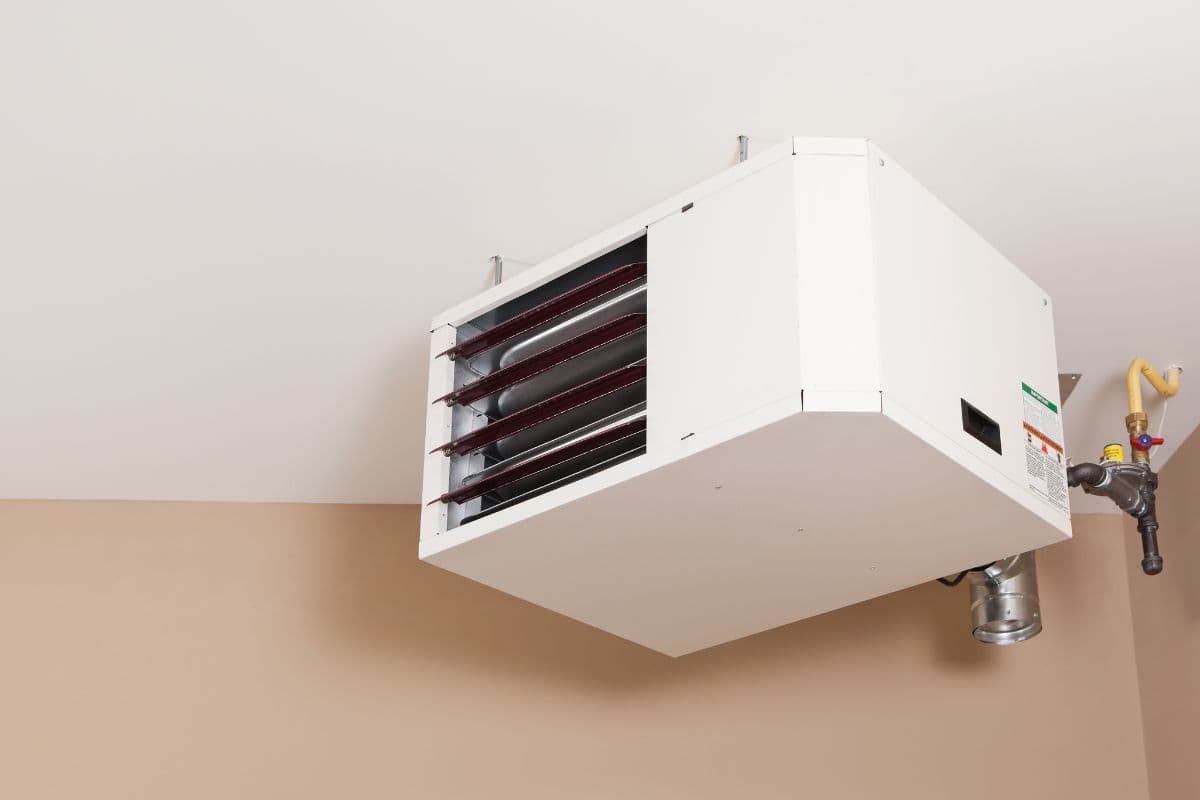
Ceiling-mounted natural gas heaters are the workhorse of serious garage heating. The most cost-effective option for regular use in medium to large garages where a gas line is available.
Purchase cost:
$400-$2,000
Installation:
$500-$2,000 (existing gas) / $1,500-$4,000 (new line)
BTU range:
30,000-125,000 BTU
Operating cost:
$0.20-$0.50/hr
Best for:
Regular use, larger garages, cold climates
Advantages
- Lowest operating cost per BTU
- Powerful enough for any residential garage
- 15-25 year lifespan
Disadvantages
- Requires professional installation
- Must be vented to the outside
- Gas line adds significant upfront cost
Portable Propane Heaters
Portable propane heaters require zero installation and work anywhere. Best for occasional weekend use, detached garages without electrical service, and power outages.
Purchase cost:
$80-$300
Installation:
None required
BTU range:
4,000-30,000 BTU
Operating cost:
$0.60-$0.80/hr at 18,000 BTU
Best for:
Occasional use, no electrical service, power outages
Advantages
- Zero installation, works anywhere
- No electrical service needed
- Works during power outages
Disadvantages
- Requires ventilation at all times
- Never leave running unattended
- Propane cost adds up with regular use
Mini-Split Heat Pumps
Mini-split heat pumps are the most efficient electric heating option. They move heat from outside air into the garage, producing 2-3 BTUs of heat per BTU of electricity consumed. They also provide air conditioning in summer.
Purchase cost:
$700-$2,500
Installation:
$0 (DIY) / $1,000-$3,000 (professional)
BTU range:
9,000-36,000 BTU
Operating cost:
$0.20-$0.45/hr (most efficient electric)
Best for:
Year-round use, heating and cooling from one unit
Advantages
- Most efficient electric heating available
- Also cools in summer
- No combustion, no venting
Disadvantages
- Highest upfront cost
- Capacity drops in extreme cold (below 0°F)
- Still requires a 240V dedicated circuit
Operating Cost Comparison
Costs below assume 4 hours of use per day, 5 days per week, for 20 weeks (a typical heating season). Local energy prices significantly affect these numbers.
| Heater Type | Cost Per Hour | Season Total | Notes |
|---|---|---|---|
| Natural gas (45,000 BTU) | ~$0.49 | ~$196 | Lowest cost, requires gas line |
| Mini-split heat pump | ~$0.27 | ~$107 | Most efficient electric, also cools |
| Propane portable (18,000 BTU) | ~$0.69 | ~$276 | No installation, needs ventilation |
| Electric 240V (5,000W) | ~$0.80 | ~$320 | At $0.16/kWh national average |
| Electric 120V (1,500W) | ~$0.24 | ~$96 | Low output, spot heating only |
Garage Heater Safety
Garage heaters involve high voltages, combustion, or both. These rules protect your family and property.
Carbon Monoxide Detection
Any combustion heater (propane, natural gas) produces carbon monoxide. Install a battery-operated CO detector and test it monthly. Never run a combustion heater in a fully sealed garage.
Electrical Safety
240V heaters must be on dedicated circuits with properly rated wire gauge. A 5,000W heater draws 20.8 amps at 240V and needs a 30-amp breaker with 10-gauge wire minimum. Never use extension cords with high-wattage heaters. All hardwired installations should be performed by a licensed electrician.
Clearance Requirements
Maintain minimum clearances from combustible materials as specified by the manufacturer: typically 18-36 inches for gas units, 12-24 inches for electric. Never store gasoline, paint, solvents, or other flammables near any heater.
Permits
Most jurisdictions require a permit for hardwired 240V heaters, natural gas heaters, and propane heaters. Portable plug-in heaters typically do not require a permit. Check with your local building department before installation.
Frequently Asked Questions
How many BTUs do I need to heat a two-car garage?
A well-insulated two-car garage (400-500 sq ft) needs approximately 10,000-20,000 BTU. A poorly insulated or uninsulated two-car garage in a cold climate may need 40,000-60,000 BTU.
Is it cheaper to heat a garage with gas or electric?
Natural gas costs roughly $0.20-$0.50 per hour for 45,000 BTU. Electric runs $0.50-$1.30 per hour for the same output. Mini-split heat pumps are the exception and are cost-competitive with gas in moderate climates.
Are propane heaters safe in a garage?
Portable propane heaters rated for indoor use (with ODS sensors) are safe in garages with adequate ventilation. Never run any propane heater in a completely sealed garage. Keep a window cracked or door open 2-4 inches and install a carbon monoxide detector.
Do I need a permit to install a garage heater?
Most jurisdictions require a permit for hardwired 240V electric heaters, natural gas heaters, and propane heaters. Portable plug-in heaters typically do not. Check with your local building department before installation.
What is the most efficient way to heat a garage?
A mini-split heat pump is the most efficient electric option, producing 3+ BTUs per BTU of electricity. Natural gas is the most cost-effective combustion option. Insulating the garage first is the highest-leverage action before buying any heater.
Related Articles
Get Expert Garage Help
Connect with qualified garage professionals in your area. Free quotes, no obligation.