The Garage Guide
Updated Apr 2026 · 13 min read
Garage Door Making Noise? Diagnose the Sound and Fix It
Map every common noise to its source, learn what is happening, and know whether you can fix it yourself or need to make a call.
TL;DR
Most garage door noises come from one of five components: rollers, hinges, springs, the opener drive system, or loose hardware. Squeaking and grinding usually mean dry or worn rollers and hinges — a $10 can of silicone lubricant fixes most of these in 15 minutes. A single loud bang almost always means a spring broke — stop using the door and call a pro. Rattling usually means loose hardware — tighten everything with a socket wrench. A loud chain or screw drive opener is not broken, it is just old. Belt drive and DC motor openers run nearly silent. Never use WD-40 on any garage door component. It is a solvent, not a lubricant, and it attracts dirt that accelerates wear on the exact parts you are trying to protect.
The garage door started making a noise you do not remember it making before. Maybe it has been getting gradually louder over the past few months. Maybe it was sudden — a new grinding sound this morning, a squeak that was not there yesterday, or one loud bang that brought you out of bed at 6am.
Garage door noises are not random. Every sound has a specific cause, a specific component, and a specific fix. The difference between a noise that costs $10 to fix today and a noise that costs $600 to fix next month is knowing which one you have right now.
This guide maps every common garage door noise to its source, tells you exactly what is happening, and tells you whether you can fix it yourself or need to make a call.
The Sound Test: How to Diagnose the Noise
Before looking at any component, do The Sound Test — a 60-second diagnostic that narrows down the cause before you touch anything.
Stand inside the garage with the door closed. Operate the door through one complete open-and-close cycle and answer these four questions:
1. When does the noise happen?
- At startup only (first few inches of travel)
- Throughout the entire travel
- Only at the end of travel (door fully open or fully closed)
- Randomly during travel
2. What does it sound like?
- Grinding or scraping
- Squeaking or squealing
- Banging or popping (single loud event)
- Rattling or vibrating
- Clicking or clunking
- Straining or humming (motor sound)
3. Which direction?
- Only when opening
- Only when closing
- Both directions
4. Where does the sound come from?
- From the door itself (panels, rollers, hinges)
- From the tracks
- From the springs above the door
- From the opener motor unit on the ceiling
The combination of these four answers points directly at the cause. Use the diagnosis table below to match your answers to the source.
One noise requires immediate action.
A single loud bang, like a gunshot from the garage, almost always means a torsion spring broke. This is not a noise to diagnose and research later. Stop using the door immediately. Do not use the opener. The door has lost its counterbalance and can drop unexpectedly. See our garage door spring replacement guide for what to do next.
Sound Diagnosis Table
| Sound | When It Happens | Most Likely Component | Cause | DIY or Pro |
|---|---|---|---|---|
| Squeaking | Throughout travel | Rollers, hinges | Dry bearings or dry hinge pins | DIY: lubricate |
| Grinding | Throughout travel | Rollers | Worn roller bearings or flat spots | DIY if minor, Pro if replacement |
| Grinding | Startup only | Opener drive gear | Worn drive gear or chain/screw needs lube | DIY: lubricate drive |
| Scraping | Throughout travel | Bottom of door on track | Misaligned track or worn bottom seal | DIY: adjust track gap |
| Loud bang | Single event | Torsion spring | Spring broke | Pro immediately |
| Popping | Throughout travel | Springs | Spring coils binding or dry | DIY: lubricate springs |
| Rattling | Throughout travel | Hardware | Loose nuts, bolts, hinges | DIY: tighten hardware |
| Rattling | At end of travel | Opener hardware | Loose opener mounting bolts | DIY: tighten mounting |
| Clunking | End of travel | Limit switch | Door traveling too far open or closed | DIY: adjust limit switch |
| Clicking | Throughout travel | Roller stems | Worn roller stems in hinge socket | DIY if light, Pro if severe |
| Straining hum | Throughout travel | Opener motor | Door unbalanced or opener underpowered | Test balance, Pro if spring issue |
| Vibration | Throughout travel | Opener mounting | Loose opener bracket or aging motor | DIY: tighten mounting |
| Slapping | Closing only | Bottom seal | Worn or detached bottom weatherseal | DIY: replace seal |
Fix by Noise Type
Squeaking and Squealing
What is happening: The metal-on-metal contact between roller wheels and track, hinge pins and hinge barrels, or roller stems and hinge sockets is running without lubrication. The friction produces a high-pitched squeal.
The fix: Lubrication. This is the most common garage door noise and the easiest to fix.
What to use: White lithium grease or silicone-based garage door lubricant. These products cling to metal surfaces, reduce friction, and do not attract dust the way general-purpose oils do.
What NOT to use: WD-40. This is critical and worth explaining properly. WD-40 is a water displacement and cleaning solvent, not a lubricant. It removes old grease and surface rust effectively, which is why it temporarily reduces noise but leaves no lasting lubricant film. Within days, the metal surfaces are drier than before and collecting the airborne dust that WD-40 attracted. The noise returns worse than before and the components wear faster.
How to lubricate the door:
Step 1: Disconnect the opener and manually cycle the door to access all rollers and hinges.
Step 2: Apply lubricant to the roller bearings — the small bearings visible inside the wheel of each roller. Rotate each roller by hand after applying to distribute the lubricant inside the bearing.
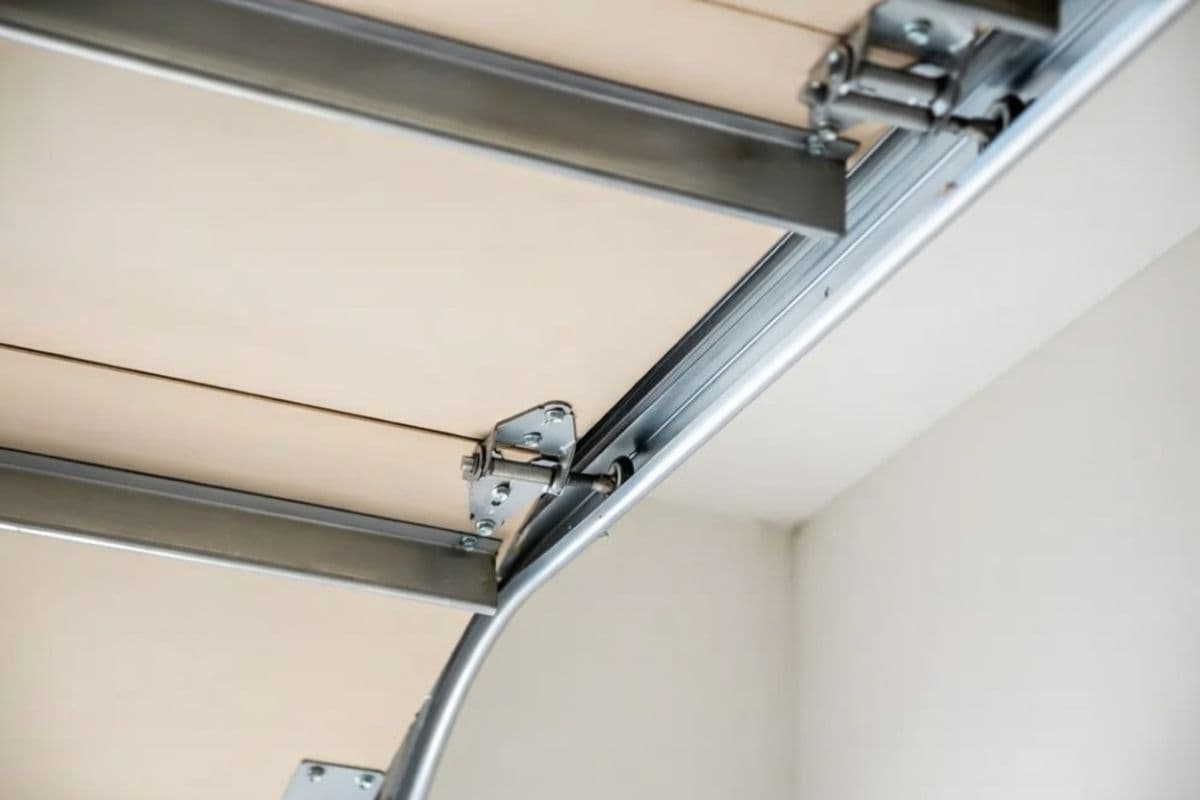
Step 3: Apply lubricant to each hinge pin, the steel pin that the hinge barrel rotates around. Work the hinge open and closed after applying.
Step 4: Apply a thin coat to the torsion spring coils. Run lubricant along the length of the spring. This reduces friction between coils and prevents the popping sound springs make when dry.
Step 5: Apply lubricant to the top of both tracks where the rollers contact the track surface. Do not spray the inside of the track channel — this attracts dirt and causes rollers to slide rather than roll.
Step 6: Wipe off any excess. Reconnect the opener and test.
Total time: 15 to 20 minutes. Total cost: $8 to $15 for a can of lubricant.
Grinding
What is happening: A grinding sound indicates metal-on-metal contact with actual surface wear occurring — harder to fix than squeaking and more urgent.
Grinding throughout travel (rollers): Steel rollers with worn bearings develop flat spots or wobble in the track. The flat spot contacts the track once per revolution with a grinding pulse. Run your hand along each roller while the door is stationary (opener disconnected) and feel for wobble, flat spots, or rough bearing movement. Worn rollers need replacement, not lubrication.
Replacing rollers: Nylon rollers with sealed ball bearings are quieter, last longer (10 to 15 years vs 5 to 7 years for steel), and do not need lubrication. A full set of rollers costs $25 to $60 for a standard door. Replacing rollers requires removing the roller stem from the hinge. This is straightforward on most doors but requires keeping the door stationary and working safely. If comfortable with basic tools, this is a DIY repair. If the door has extension springs rather than a torsion spring, replacing bottom rollers requires caution around the cable tension.
Grinding at startup (opener drive gear): A grinding sound only when the opener first engages often means the drive gear inside the opener is worn. Chain drive and screw drive openers develop this sound as the gear teeth wear. A worn drive gear that is ignored will eventually strip completely and leave the opener unable to move the door. Drive gear replacement costs $50 to $150 in parts plus labor, or $15 to $40 as a DIY repair if your opener model has available replacement parts.
Banging and Popping
Single loud bang: almost certainly a broken spring. Do not use the door. See our garage door spring replacement guide. The cost to replace a torsion spring professionally is $200 to $350.
Popping throughout travel (dry spring coils): The torsion spring is made of tightly wound coils. When the coils are dry, they bind against each other as the spring winds and unwinds, releasing with an audible pop. This is a warning that the spring needs lubrication and is under more stress than it should be. Lubricate the spring as described in the squeaking section above. If the popping continues after lubrication, have the spring tension evaluated. An overtightened spring produces excessive coil-to-coil friction.
Banging at end of travel (limit switch misadjusted): If the door bangs when it reaches the fully open or fully closed position, the opener's travel limits are set too far. The motor drives the door past its natural stopping point and slams it against the stop bolts or the floor. Limit switch adjustment is a straightforward DIY fix using the adjustment screws on the opener motor unit. Consult your opener's manual for the specific procedure.
Banging during travel (loose track mounting): A track that has partially pulled away from the wall will flex and bang as the rollers pass through it. Check all track mounting brackets and tighten any loose lag bolts. If the wall anchor itself has failed, the bracket needs to be remounted into a stud.
Rattling
Rattling almost always means loose hardware. Garage doors cycle thousands of times per year and the vibration gradually loosens every nut, bolt, and screw in the system.
The fix: Systematic tightening.
Use a socket wrench and work through every visible piece of hardware on the door and track system:
- All track mounting brackets to the wall
- All hinge mounting screws on the door panels
- All roller stem bolts
- The opener mounting bracket to the ceiling
- The opener rail mounting hardware
- The header bracket where the track curves
Do not overtighten. Snug is correct. Overtightening strips the fasteners and creates a different problem.
Anti-vibration hardware: If the opener itself rattles against its mounting bracket, rubber anti-vibration pads (sold specifically for garage door openers, $8 to $15) installed between the opener and the ceiling mount significantly reduce transmitted vibration noise inside the house.
Opener Noise: Chain vs Belt vs Screw Drive
One of the most common sources of complaints about a “noisy garage door” is actually a noisy opener. The three drive systems have very different noise profiles:
Chain drive: The most common and least expensive opener type. The metal chain running on the rail produces a characteristic rattling sound during operation. This is normal for chain drive systems, not a sign of failure. Keeping the chain properly tensioned and lubricated reduces the noise but does not eliminate it.
Screw drive: A threaded steel rod drives the carriage. Produces a grinding or scraping sound as it operates, particularly in temperature extremes where the lubricant on the screw becomes thick in cold or thin in heat. Lubricate the screw rod with the manufacturer-recommended lubricant twice per year.
Belt drive: Uses a rubber belt instead of metal chain or screw. Significantly quieter than chain or screw drive. If you have a chain or screw drive opener and the noise is the primary complaint, replacing the opener with a belt drive or direct drive unit is the most permanent solution. Modern belt drive openers cost $180 to $350 and run at near-silent levels.
DC motor vs AC motor: Older openers use AC motors that are louder at startup and during operation. Modern DC motor openers start more smoothly, run more quietly, and include soft start and soft stop features that reduce the mechanical noise of the door reaching end of travel.
The Balance Test: Is the Door Causing the Noise?
An unbalanced door creates noise throughout the system because every component is working harder than it should. A door that is not properly counterbalanced by its springs strains the opener motor, wears rollers faster, and puts stress on the track mounting hardware.
How to test balance:
- Disconnect the opener using the red emergency release cord
- Manually lift the door to waist height (approximately 3 to 4 feet)
- Release the door and step back
A balanced door stays in place at waist height with minimal drift. A door that drops quickly is heavy on the bottom — springs are losing tension. A door that rises on its own is heavy on the top — springs are overtensioned.
An unbalanced door should be evaluated by a professional. Adjusting spring tension requires winding bars and knowledge of spring specifications. Do not attempt spring tension adjustment yourself.
Cost of Fixing Each Noise Source
| Problem | DIY Cost | Professional Cost | Urgency |
|---|---|---|---|
| Dry rollers and hinges (lubrication) | $8 to $15 | $75 to $150 service call | Low: fix this week |
| Worn steel rollers | $25 to $60 for roller set | $100 to $200 | Medium: fix this month |
| Loose hardware (tightening) | $0 | $75 to $150 service call | Low: fix this week |
| Dry torsion spring (lubrication) | $8 to $15 | Included in service call | Medium: fix this week |
| Broken torsion spring | Not DIY | $200 to $350 | High: do not use door |
| Worn opener drive gear | $15 to $40 parts | $100 to $200 | Medium: fix this month |
| Opener limit switch adjustment | $0 | $75 to $150 service call | Low: fix this month |
| Chain drive noise (normal operation) | $8 to $15 for lubricant | N/A | None: expected |
| Replace chain drive with belt drive | $180 to $350 new opener | $350 to $600 installed | None: preference only |
| Unbalanced door (spring adjustment) | Not DIY | $150 to $300 | Medium: fix this month |
If your old door is becoming noisy or unreliable, our replacement cost calculator can help you budget the next step before calling installers.
When to Call a Pro vs Fix It Yourself
Always call a pro for:
- A loud bang indicating a broken spring
- Any spring tension adjustment
- Drive gear replacement if not comfortable with opener disassembly
- Persistent grinding after lubrication and roller inspection
Safe DIY for most homeowners:
- Lubrication of all components
- Hardware tightening
- Roller replacement (except bottom rollers on extension spring systems)
- Opener limit switch adjustment
- Anti-vibration pad installation
The line: If the fix requires releasing or adjusting spring tension, it requires a professional. Everything else is generally within the capability of a homeowner who is comfortable with basic tools.
For additional safety information, see the U.S. Consumer Product Safety Commission: Garage Door Operators.
Frequently Asked Questions
Why is my garage door suddenly so loud?
A sudden increase in noise almost always points to one of three things: a spring that broke (single loud bang), a roller bearing that failed (sudden grinding), or hardware that worked loose (sudden rattling). A loud bang from the garage at any hour of the day or night almost certainly means a torsion spring broke. Do not use the door until the spring is replaced. For grinding or rattling that appeared suddenly, disconnect the opener and manually inspect the rollers, hinges, and track hardware before attempting to operate the door again.
What is the best lubricant for a garage door?
Use white lithium grease or a silicone-based garage door lubricant. Both products cling to metal surfaces, reduce friction, and do not attract dust and debris. Apply to rollers, hinges, the torsion spring, and the top of the tracks. Do not use WD-40 — it is a cleaning solvent that temporarily reduces noise but leaves no lasting lubricant film and attracts dirt that accelerates wear. Do not use general-purpose grease or motor oil, which are too thick, collect debris, and can make noise worse over time.
Can a noisy garage door damage the opener?
Yes. An unbalanced door, seized rollers, or misaligned tracks force the opener motor to work harder than it was designed to, shortening the motor lifespan. A chain drive opener running a door with seized rollers can strip the drive gear. An unbalanced door running on an entry-level opener can burn out the motor over dozens of cycles. Fixing the noise source protects the opener, not just the door.
Why does my garage door squeak after I already lubricated it?
If squeaking returns quickly after lubrication, one of three things is happening: wrong lubricant (WD-40 evaporates within days), insufficient lubrication (the bearing needs lubricant inside the bearing, not just on the surface), or the rollers are worn beyond what lubrication can fix. Steel rollers with worn or failed bearings produce a squeak that lubrication temporarily masks but does not resolve. Inspect each roller for wobble, flat spots, or rough bearing movement. If the rollers are worn, replacement is the correct fix.
How often should I lubricate my garage door?
Every six months is the standard recommendation. Twice per year, typically spring and fall during your seasonal maintenance, keeps all components running smoothly and prevents friction-related wear that leads to premature roller and hinge failure. If your garage is in a particularly humid, coastal, or dusty environment, quarterly lubrication extends component life. See our garage door maintenance guide for the complete seasonal maintenance schedule.
Is a noisy garage door dangerous?
It depends on the noise. Squeaking and rattling are annoying but not immediately dangerous. A single loud bang from the garage almost certainly means a spring broke — the door is now dangerous to operate and should not be used until the spring is replaced. A grinding noise that is getting progressively louder over weeks indicates accelerating wear that will eventually result in component failure. A straining motor sound combined with a door that feels heavy when operated manually indicates spring failure or significant loss of spring tension.
Why does my garage door make a noise only in cold weather?
Cold weather causes lubricants to thicken and metal components to contract. Grease that was adequate in summer becomes stiff in winter, increasing friction and noise. A screw drive opener is particularly sensitive to temperature — the lubricant on the screw rod thickens in cold weather and produces a grinding or scraping sound. Apply fresh lubricant rated for low temperatures in late fall. Cold weather also causes the torsion spring to lose some tension as the metal contracts, which can make the door feel heavier and the opener sound like it is straining.
My garage door opener is loud but the door seems fine. What should I do?
The opener itself is the noise source. First, check whether it is a chain drive or screw drive system — these are inherently louder than belt drive systems and the noise may be normal operation rather than a problem. Lubricate the chain or screw drive per the manufacturer's instructions. Check that the opener mounting bracket is tight and install anti-vibration pads if the noise transmits into the house. If the opener is over 10 years old and the noise has been increasing, a worn drive gear or aging motor may be the cause. At that age, replacing the opener with a modern belt drive DC motor unit is often more cost-effective than repairing a chain drive opener.
Related Guides
Garage Door Spring Replacement
What to do when a loud bang means a spring broke.
ProblemGarage Door Off Track
When scraping and grinding leads to the door coming off its track.
ProblemGarage Door Opener Not Working
When the noise comes from a struggling opener.
GuideGarage Door Maintenance
The seasonal lubrication and inspection schedule that prevents noise.
ProblemGarage Door Weather Stripping
If the noise is a slapping or dragging sound from the bottom seal.
Glossary
Torsion spring
The large coiled spring mounted horizontally above the garage door that counterbalances the door weight. When it breaks, it releases its stored energy with a loud bang and leaves the door without counterbalance. The most urgent noise-related problem a garage door owner faces. Must be replaced by a professional.
Roller bearing
The ball bearing assembly inside the wheel of each garage door roller that allows the wheel to spin freely around the roller stem. Sealed nylon roller bearings last 10 to 15 years and run quietly. Open steel roller bearings last 5 to 7 years, are louder, and require periodic lubrication. Failed bearings produce grinding and squeaking that lubrication cannot fix.
Drive gear
The plastic or nylon gear inside the opener motor unit that engages the chain, belt, or screw drive system. Drive gears wear over time and produce a grinding sound at startup when worn. A completely stripped drive gear leaves the opener motor running but the door not moving. Drive gear replacement is a common repair on openers over 8 to 10 years old.
Chain drive
An opener system that uses a metal chain running on a rail to move the carriage and door. The most common and least expensive opener type. Produces a characteristic rattling sound during operation that is normal for the drive type, not a sign of failure. Requires periodic chain lubrication and tension adjustment.
Belt drive
An opener system that uses a rubber or fiberglass-reinforced belt instead of a metal chain. Significantly quieter than chain drive. The preferred option for attached garages where opener noise transmits into living spaces. Costs $50 to $100 more than a comparable chain drive opener.
Limit switch
The adjustment mechanism on the opener motor unit that controls how far the door travels in each direction before the motor stops. An incorrectly set limit switch causes the door to bang against the floor or stop bolts at end of travel. Most modern openers use electronic limits set automatically during installation. Older openers have manual adjustment screws.
Anti-vibration pads
Rubber pads installed between the opener motor unit and the ceiling mounting bracket that absorb vibration and reduce the amount of operational noise transmitted through the ceiling into living spaces above the garage. Cost $8 to $15 and install in minutes. Particularly effective for chain drive openers in attached garages.
Screw drive
An opener system that uses a threaded steel rod to move the carriage along the rail. Produces a grinding or scraping sound during operation, particularly in temperature extremes where lubricant thickens in cold or thins in heat. Requires lubrication of the threaded rod twice per year with manufacturer-recommended lubricant. Less common than chain or belt drive but found in many older openers installed in the 1990s and 2000s.
Hinge
The metal bracket that connects adjacent door panels and holds the roller stem. Hinge pins are the steel pins around which the hinge barrels rotate and are a primary source of squeaking when dry. A bent or cracked hinge contributes to roller misalignment and uneven noise throughout travel. Hinges are inexpensive and should be replaced if visibly damaged.