The Garage Guide
Updated Mar 2026 · 30 min read
The Complete Garage Organization Guide 2026: Zones, Systems, and Step-by-Step Plans
A fully organized two-car garage costs $500 to $5,000. The single most important decision is how you divide the space into zones before you spend a dollar.
Roughly 25% of homeowners with two-car garages cannot park even one car inside because of accumulated clutter. The U.S. garage storage market hit $3.46 billion in 2024 and is growing at nearly 8% annually — more products exist than ever, but more products without a plan just creates expensive clutter.
This guide walks you through the entire process: assessing your garage, creating a zone-based layout, choosing the right storage systems for each zone, building a workbench area, handling hazardous materials safely, and maintaining the system year-round.
Every recommendation connects to a deeper guide or product review elsewhere on this site so you can go as deep as you need on any single topic.
If you are setting up a dedicated workshop rather than general storage, see our garage workshop setup guide for a full planning walkthrough including electrical, lighting, and zone design.
Why Most Garage Organization Projects Fail
The pattern is predictable. A homeowner spends a Saturday afternoon buying shelves, bins, and hooks from a home improvement store. Everything looks great for three weeks. By month two, the shelves are overloaded, the bins are unlabeled, and new items have started piling on the floor because there is no designated spot for them.
The failure is almost never about the products. It is about skipping two critical steps: decluttering first and zoning the space before buying anything. Products solve storage problems. They do not solve clutter problems or layout problems.
Step 1: Measure Your Garage
Before you declutter a single item, measure your space. You need five numbers: width (wall to wall), depth (door to back wall), ceiling height (floor to lowest obstruction), door track clearance (floor to bottom of garage door track), and vehicle footprint.
Standard Garage Dimensions
| Garage Type | Typical Width | Typical Depth | Square Footage |
|---|---|---|---|
| 1-car | 12 to 16 ft | 20 to 24 ft | 240 to 384 sq ft |
| 2-car | 20 to 24 ft | 20 to 24 ft | 400 to 576 sq ft |
| 3-car | 31 to 36 ft | 20 to 24 ft | 620 to 864 sq ft |
According to the National Association of Home Builders, 65% of new homes built in the U.S. include a two-car garage, making the 20 to 24 foot wide by 20 to 24 foot deep footprint the most common layout.
The depth calculation most people miss: Your parked vehicle needs roughly 2 to 3 feet of clearance on each side for opening doors. In a 22-foot-deep garage with a 16-foot-long vehicle, you have approximately 6 feet of usable depth behind the car. This rear zone is the most valuable storage real estate in the entire garage.
Step 2: Declutter Before You Organize
Organizing clutter is just rearranging a problem. The declutter phase is the single highest-ROI step in the entire project because it is free, it reduces the amount of storage you need to buy, and it prevents you from investing in systems sized for things you should not keep.
The Four-Sort Method
Pull everything out of the garage onto the driveway. Sort every item into one of four categories:
- Keep in the garage. Tools, seasonal gear, sports equipment, automotive supplies, and anything you use at least once per season that logically belongs in the garage.
- Keep but relocate. Items that belong in the house, attic, basement, or a storage unit. Old tax files, childhood memorabilia, and surplus kitchen appliances do not belong in a garage where temperature and humidity fluctuate.
- Sell or donate. Functional items you have not used in over a year. If you have not touched it in 12 months, the probability that you will use it in the next 12 months is near zero.
- Trash or recycle. Broken items, expired chemicals, dried-out paint cans, mystery boxes. Be ruthless. Every item you keep costs you storage space and mental overhead.
The 20% rule: Most homeowners discover they can eliminate 20% to 40% of their garage contents during a thorough declutter. If your garage is packed, the first declutter alone may free enough space to park a car without buying a single storage product.
Disposal Tips for Common Problem Items
| Item | How to Dispose |
|---|---|
| Old paint (latex) | Dry it out with cat litter, dispose in regular trash |
| Old paint (oil-based) | Take to household hazardous waste collection |
| Car batteries | Return to auto parts store (most accept free) |
| Old gasoline | Take to hazardous waste collection — never pour down drain |
| Electronics | E-waste recycling drop-off or retailer take-back programs |
| Tires | Tire retailers typically accept old tires for $3 to $5 each |
| Expired fire extinguishers | Contact local fire department for guidance |
| Broken power tools | Small appliance recycling at local transfer station |
Step 3: Create Your Zone Plan
Zones are the backbone of a garage that stays organized. Instead of treating the garage as one giant room, divide it into distinct areas based on function and access frequency. Items you use daily go in the most accessible spots. Items you use twice a year go in the hardest-to-reach areas.
The Five-Zone System
| Zone | Location | What Goes Here | Access Frequency |
|---|---|---|---|
| Transition Zone | Wall adjacent to house entry door | Shoes, coats, backpacks, keys, dog leashes | Multiple times daily |
| Active Zone | Side walls at eye level | Hand tools, sports gear, car supplies, cleaning supplies | Weekly |
| Workshop Zone | Back wall behind parked cars | Workbench, power tools, project materials | Weekly to monthly |
| Bulk Storage Zone | Overhead ceiling racks | Seasonal decorations, camping gear, luggage, bulk supplies | A few times per year |
| Hazardous Materials Zone | Locked cabinet, away from ignition sources | Paint, solvents, fertilizer, pesticides, gasoline | As needed |
Zone Layout by Garage Type
One-Car Garage (240 to 384 sq ft)
Space is tight. Skip the workshop zone unless you use a wall-mounted folding workbench. Prioritize the transition zone near the house door and use one full side wall as the active zone. The back wall becomes your primary storage area with shelving. Use ceiling racks aggressively since vertical space is your only real expansion option.
Two-Car Garage (400 to 576 sq ft)
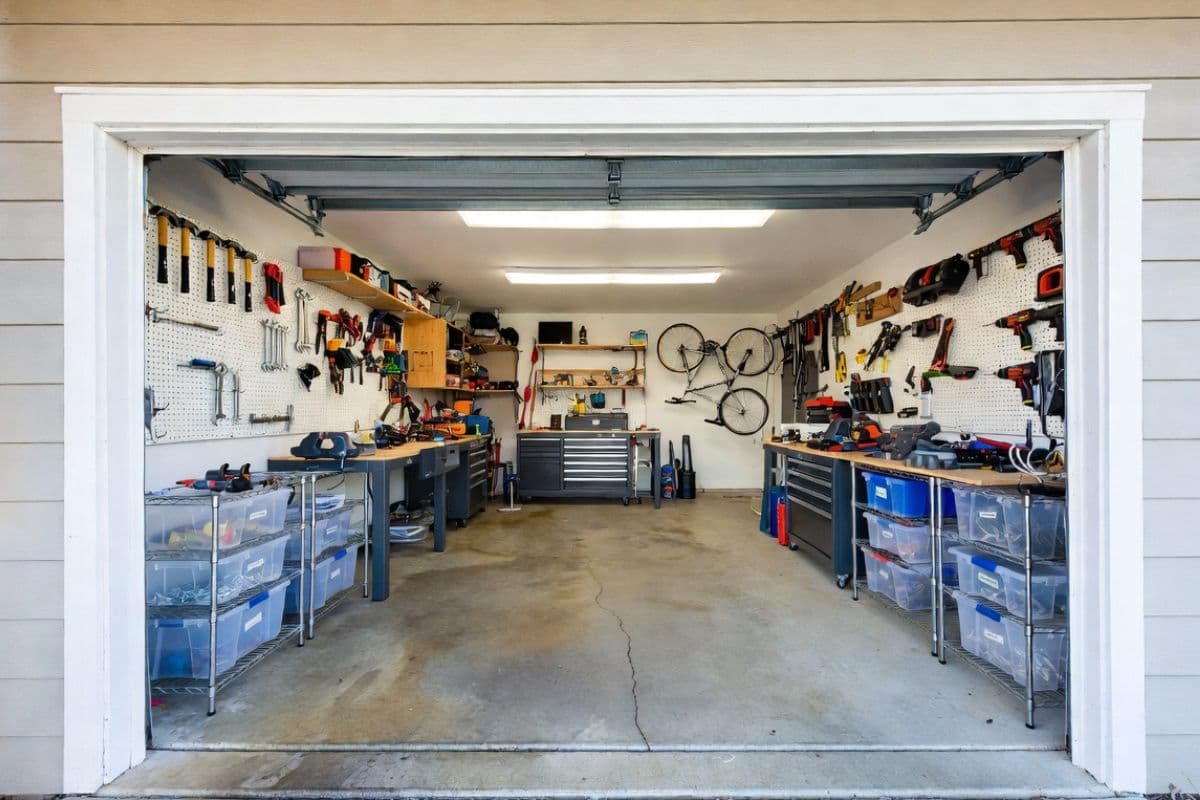
The most common layout. Dedicate the back wall to a workshop zone with a 5 to 6 foot workbench. Use both side walls for active zone storage — tools on one side, sports and outdoor gear on the other. Install one or two 4x8-foot ceiling racks for seasonal storage. Place the transition zone near the house entry door.
Three-Car Garage (620 to 864 sq ft)
You have room for a dedicated workshop bay. Consider designating one full bay as a combined workshop and active storage zone. The extra wall space allows for cabinet systems that create a finished, showroom-quality look.
The 18-Inch Rule
Keep the first 18 inches of floor space along every wall completely clear. This buffer zone prevents items from creeping into the driving and walking path, makes sweeping and cleaning possible, and ensures you can always access wall-mounted storage.
Step 4: Choose Storage Systems by Zone
Each zone has different requirements. Buying the wrong system for a zone is the second most common reason garage organization fails (after skipping the declutter).
Transition Zone Storage
The transition zone works like a mudroom. If your garage door is your family's primary entrance, this zone handles the daily chaos of shoes, jackets, backpacks, and keys.
- Wall-mounted locker systems or open cubbies ($100 to $400 per section) give each family member a dedicated slot
- A small bench with shoe storage underneath ($50 to $200) keeps footwear off the floor
- Key hooks and a mail slot ($10 to $30) prevent the “where are my keys” problem
Budget option: A simple coat rack with a shoe tray beneath it costs under $50 and handles 90% of the transition zone function.
Active Zone Storage (Walls)
The active zone is where you interact with your garage daily or weekly. Everything here should be visible, accessible, and between your knees and your head. There are three main wall storage systems:
Track Systems (Slatwall or Channel-Based)
Most flexible. Accessories slide along the track and can be repositioned in seconds without drilling new holes. Best for garages where your needs change over time. Expect to spend $100 to $400 per wall. Our storage systems review covers top picks.
Metal Pegboard
Best for tool organization where you want every item visible and in a fixed position. Steel pegboard is roughly ten times stronger than fiberboard pegboard. Expect to spend $80 to $300 per wall.
Cabinet Systems
Best for a clean, finished look and for securing valuable tools or hazardous materials behind doors. Freestanding cabinets ($90 to $4,000) require no wall mounting. Wall-mounted cabinets ($90 to $2,000) free up floor space.
Which Wall System Should You Choose?
| Priority | Best System | Why |
|---|---|---|
| Maximum flexibility | Track system (slatwall/channel) | Repositionable accessories, grows with your needs |
| Tool visibility | Metal pegboard | Every tool visible, easy grab-and-return |
| Clean finished look | Cabinet system | Hides clutter, lockable, dust-free |
| Budget under $200 | Metal pegboard + basic hooks | Most storage per dollar at small scale |
| Rental property (temporary) | Freestanding shelving | No wall mounting needed, portable |
Overhead Storage (Ceiling Racks)
Overhead ceiling racks turn dead space above your parked car into high-capacity storage. A single 4x8-foot rack holds 400 to 600 lbs and provides 32 square feet of platform storage, enough for 10 to 15 large bins. Most two-car garages can accommodate two ceiling racks.
- Mount into ceiling joists only, never into drywall alone
- Verify joist direction and spacing (16 or 24 inches on center) before purchasing
- Maintain minimum 2-inch clearance between stored items and your tallest vehicle
Our full ceiling rack recommendations are covered in the garage storage systems review.
Pro tip for overhead storage: Use clear-sided or labeled bins exclusively. Label every bin on two sides (front and bottom) so you can read the contents whether standing next to the rack or looking up from below.
Hazardous Materials Zone
Every garage contains at least a few hazardous materials — gasoline, paint and stain, automotive fluids, fertilizers, pesticides, and cleaning solvents. Proper storage is not optional. Garage fires caused by improper chemical storage are a leading cause of residential fire damage.
Safety Rules for Flammable Storage
- Store gasoline in approved safety containers only (maximum 5 gallons per container per OSHA standards)
- Keep total flammable liquid storage under 10 gallons in a residential garage
- Store all flammable liquids in a metal cabinet away from ignition sources (water heater, furnace, electrical panel)
- Never store flammable liquids near the garage door opener motor
- Maintain at least one rated fire extinguisher (minimum 2A:10B:C) near the garage exit door
- Keep a clear path to the exit at all times
Chemical Storage Separation Rules
| Category | Examples | Storage Rule |
|---|---|---|
| Flammable liquids | Gasoline, paint thinner, acetone | Metal cabinet, away from heat sources |
| Oxidizers | Pool chemicals, fertilizers with ammonium nitrate | Separate from flammable liquids by at least 20 feet |
| Corrosives | Muriatic acid, battery acid | Low shelf in secondary containment tray |
| Pesticides/herbicides | Weed killer, insect spray | Locked cabinet, away from food and pet supplies |
| Automotive fluids | Motor oil, brake fluid, coolant | Shelf with drip tray, away from living spaces |
Step 5: Build a Workshop Zone
If you do any DIY work, car maintenance, or hobby projects, a dedicated workshop zone transforms your garage from a storage room into a functional workspace. The back wall of a two-car garage is the ideal location.
Workbench Sizing
| Your Height | Recommended Bench Height | Reasoning |
|---|---|---|
| 5′4″ to 5′7″ | 34 to 36 inches | Elbow height minus 2 to 4 inches for general work |
| 5′8″ to 5′11″ | 36 to 38 inches | Standard range for most adults |
| 6′0″ to 6′3″ | 38 to 40 inches | Prevents back strain from hunching over |
| 6′4″+ | 40 to 42 inches | Custom height essential at this range |
Recommended workbench dimensions: Width 60 to 72 inches (5 to 6 feet). Depth 24 to 30 inches. Material: 3/4-inch plywood top over a 2x4 frame is the most cost-effective option. A replaceable top is a feature, not a flaw.
Workshop Electrical Needs
- At least one dedicated 20-amp circuit for the workbench area
- GFCI protection on all garage outlets (required by code in most jurisdictions)
- A minimum of two duplex outlets within 6 feet of the workbench
- Consider a 240V outlet if you plan to run a welder, air compressor, or large table saw
For complete guidance on electrical upgrades and lighting, see our garage lighting guide. Workshop task lighting needs 75 to 100 lumens per square foot at the work surface. Mount a dedicated 4-foot LED shop light directly above the workbench, 36 to 42 inches above the work surface.
Step 6: Address the Floor
Your garage floor affects everything above it. A cracked, dusty, oil-stained concrete floor makes organization harder. You do not need to coat your floor to organize your garage, but doing so before installing storage systems is dramatically easier and cheaper than doing it after.
| Option | Cost (2-Car Garage) | DIY Friendly | Durability |
|---|---|---|---|
| Epoxy coating | $150-$650 DIY / $1,500-$4,500 pro | Yes (prep is critical) | 5 to 10 years |
| Polyurea/polyaspartic | $2,000-$5,000 pro only | No | 15 to 20 years |
| Interlocking tiles | $3-$8 per sq ft | Very easy | 10 to 15 years |
| Paint/concrete stain | $50-$200 | Yes | 1 to 3 years |
| Rubber mats | $1-$4 per sq ft | Very easy | 5 to 10 years |
For a complete breakdown, see our garage floor coating cost guide and best garage floor epoxy kits review.
Step 7: Install Systems in the Right Order
Installation order matters. Getting it wrong means redoing work or damaging finished surfaces.
- Floor coating (if doing it). Coat the floor before anything goes on the walls or ceiling. Cure times range from 24 hours (polyurea) to 7 days (some epoxies).
- Ceiling racks. Install overhead storage next. You need clear floor space and ladder access without wall-mounted items in the way.
- Wall systems and cabinets. Mount tracks, pegboard, and cabinets with the floor and ceiling done.
- Workbench. Position after wall systems are in place so you can align the bench with wall-mounted tool storage above it.
- Transition zone. Install last since it is near the door and gets in the way during all other installation work.
- Bins, hooks, and accessories. Final step. Load the systems once everything is mounted and secure.
Step 8: Label Everything
Labeling is the single cheapest step that has the biggest impact on long-term organization. Without labels, bins become mystery boxes within weeks.
- Label every bin on two sides (front and at least one additional side visible from your typical viewing angle)
- Use a label maker or printed labels, not handwritten tape that peels off
- Use broad categories, not hyper-specific descriptions (“Holiday Decorations” works; “Christmas Lights - Outdoor - Icicle Style” does not)
- For overhead bins, label the bottom so you can read it while looking up
- Color-code bins by zone: one color for seasonal, one for sports, one for tools, one for automotive
Garage Organization Budget Guide
Budget Tier: $200 to $500 (DIY Weekend)
Heavy-duty freestanding shelving (2 units, $100-$200), wall hooks and hangers ($20-$50), storage bins with lids (10-15 bins, $50-$100), label maker ($20-$30), broom and floor cleaning ($15-$30). Total: $205 to $410.
Gets you off the floor and into a functional layout. You will be able to park your car and find your tools.
Mid-Range Tier: $1,000 to $3,000
Wall track system or metal pegboard (2 walls, $200-$600), overhead ceiling rack (1-2 units, $150-$400), steel cabinet or workbench combo ($200-$800), storage bins (20 bins with labels, $100-$200), epoxy floor coating DIY ($150-$350), LED shop lights (4-6 fixtures, $60-$120), hooks and accessories ($50-$150). Total: $910 to $2,620.
The sweet spot for most homeowners. Zone-based system, coated floor, proper lighting, and enough storage for a well-organized two-car garage.
Premium Tier: $5,000 to $12,000+
Full modular cabinet system ($1,500-$4,000), professional floor coating ($2,000-$4,500), overhead ceiling racks (2-3 units, $300-$700), slatwall system full perimeter ($500-$1,500), LED lighting upgrade ($200-$500), workbench with built-in storage and power ($300-$1,500), professional installation labor ($500-$2,000). Total: $5,300 to $14,700.
Magazine-quality garage. Organized garage systems can recoup 75% to 85% of their cost in home resale value.
Seasonal Maintenance Calendar
An organized garage requires maintenance. Without a seasonal check-in, entropy wins within a year. Block 2 to 3 hours per season.
Spring (March to April)
Pull out warm-weather gear from overhead storage. Stow winter gear. Inspect the garage floor for new cracks (see our water intrusion guide if you find moisture issues). Service lawn mower and string trimmer. Check fire extinguisher pressure gauge. Sweep and mop the floor.
Summer (June to July)
Declutter pass: remove anything that accumulated since spring. Verify all chemicals and flammable liquids are properly stored (heat increases vapor pressure and fire risk). Check overhead racks for sagging or loose hardware. Clean and reorganize the transition zone.
Fall (September to October)
Swap seasonal gear. Inspect garage door weatherstripping and bottom seal. Check insulation in the garage ceiling and shared walls. Test the garage door opener safety reversal mechanism. Stock winter supplies in accessible locations.
Winter (December to January)
Minimize time with the garage door open to reduce heat loss. Ensure ice melt and snow removal tools are in the transition zone. Inventory holiday decoration bins after use and discard broken items. Tighten wall-mounted hardware that may have loosened from temperature cycling.
Common Mistakes to Avoid
Buying storage before decluttering. You will buy too much, buy the wrong sizes, and spend money solving a problem that disappears once you remove 30% of the contents.
Ignoring the ceiling. The area above your parked car is the largest unused storage zone. Two 4x8-foot ceiling racks add 64 square feet without using floor or wall space.
Storing everything on the floor. Floor storage blocks parking, creates tripping hazards, traps moisture, and makes cleaning impossible. Every item should be on a wall, shelf, rack, or in an overhead bin.
Forgetting about lighting. You cannot find things in a dark garage. Most garages are dramatically underlit. See our complete lighting guide.
Mixing frequently-used and rarely-used items. Holiday decorations should not be on the same shelf as daily-use hand tools. High-access items go at eye level on walls. Low-access items go overhead.
No maintenance schedule. Organization is not a one-time project. Without seasonal check-ins, the garage reverts to chaos within 6 to 12 months.
Frequently Asked Questions
How long does it take to fully organize a garage?
A complete garage organization project takes one to three weekends for a DIY approach. Day one is the declutter. Day two is cleaning, repairs, and floor coating if planned. Day three and beyond is installing storage systems and loading them.
Can I organize my garage without spending any money?
Yes. The declutter and zone-planning steps cost nothing and produce the biggest improvement. Rearranging existing shelves, using cardboard boxes as temporary bins, and grouping items in designated areas will produce a noticeable transformation.
What is the best garage organization system for renters?
Freestanding shelving, freestanding cabinets, and stackable bins are fully portable and require no permanent modifications. Avoid drilling into walls or ceilings.
How do I organize a garage that doubles as a workshop?
Dedicate one wall entirely to the workshop function. Install a workbench at the proper ergonomic height, mount pegboard or slatwall above it for tool access, and install task lighting directly over the work surface. Keep the workshop zone contained to one wall and the adjacent floor area.
Should I insulate my garage before organizing it?
If you plan to spend significant time working in the garage or want to protect temperature-sensitive items, insulating before organizing is strongly recommended. Our garage insulation guide covers climate zone R-values, material options, and priority order.
Does an organized garage increase home value?
Yes. Real estate agents consistently cite a clean, organized garage as a differentiator during home showings. Professional-grade systems can recoup 75% to 85% of their cost at resale, and elimination of off-site storage fees ($85 to $150 per month) provides ongoing savings.
How do I keep my garage organized with kids?
Assign each child a labeled bin or cubby in the transition zone for their sports gear, bikes, and outdoor toys. Mount bike hooks low enough for older kids to use independently. Use picture labels for younger children who cannot read.
What should never be stored in a garage?
Avoid storing food (attracts pests and spoils in temperature swings), propane tanks (store outdoors only), important documents (humidity and pests destroy paper), refrigerators or freezers on uninsulated concrete in extreme climates, and anything irreplaceable like photos or heirlooms.
Glossary
Slatwall
A wall-mounted panel system with horizontal grooves that accept insertable hooks, baskets, shelves, and specialty holders. Made from PVC, MDF, or metal.
Track system
A wall-mounted rail (typically steel or aluminum) that supports sliding, repositionable accessories. Gladiator GearTrack and Rubbermaid FastTrack are common examples.
Ceiling rack
An overhead platform mounted to ceiling joists that creates elevated storage space above parked vehicles. Typically supports 400 to 600 lbs.
GFCI outlet
Ground fault circuit interrupter. A safety outlet that cuts power when it detects current leaking to ground, preventing electrocution. Required by code in garages.
Joist spacing
The distance between the center of one ceiling joist and the next. Standard residential spacing is 16 or 24 inches on center. Critical for mounting ceiling racks.
Pegboard
A perforated panel (fiberboard or metal) that accepts pegs and hooks for hanging tools and accessories. Metal pegboard is significantly stronger and more durable than traditional fiberboard.
Secondary containment
A tray, tub, or barrier placed under chemical containers to catch spills and prevent floor contamination. Required for corrosive and hazardous liquid storage.
R-value
A measure of thermal resistance in insulation. Higher R-values indicate better insulating performance. See our insulation guide for garage-specific recommendations.
Related Articles
Best Garage Storage Systems 2026
Wall-mounted tracks, overhead ceiling racks, and modular cabinets reviewed and ranked.
COST GUIDEGarage Floor Coating Cost 2026
Compare epoxy, polyurea, and polyaspartic options with real pricing and pros and cons.
REVIEWBest Garage Floor Epoxy Kits 2026
We tested and ranked 5 DIY epoxy kits by durability, ease of use, and value.
GUIDEHow to Insulate Your Garage
Complete DIY guide including vapor barriers, R-values by climate zone, and step-by-step installation.
REVIEWBest Garage Lighting 2026
LED options for every budget with lumen recommendations by garage size.
PROBLEMWater Leaking Into Garage
Diagnose and fix the 6 most common causes of water intrusion in your garage.
Get Free Quotes for Garage Organization
Connect with local contractors who specialize in garage storage systems, floor coatings, and custom organization.